


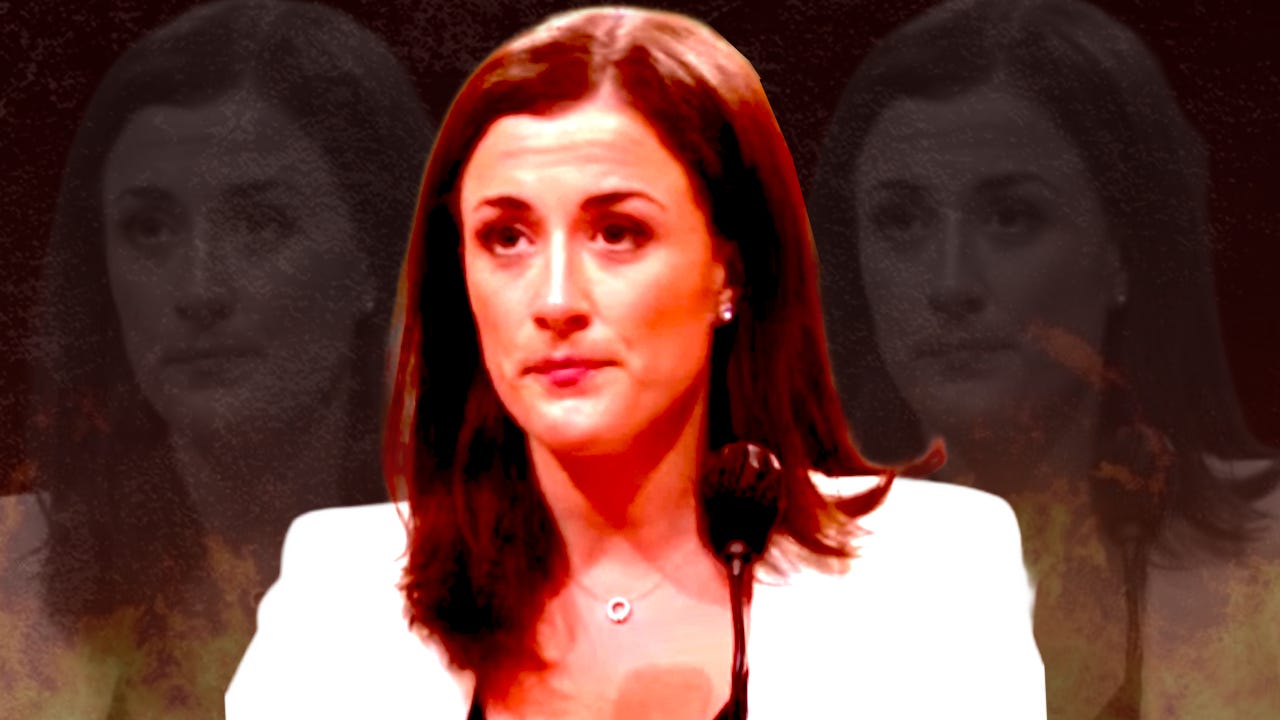
Cassidy Hutchinson, born in 1996, is a former congressional and White House staff aide who rose from relative obscurity to national prominence through her work for Chief of Staff Mark Meadows during the Trump Administration. A graduate of Christopher Newport University, she previously interned on Capitol Hill before serving in the White House Office of Legislative Affairs and later as Meadows’s assistant. In June 2022, at just 25 years old, she became one of the most publicized witnesses before the January 6 Committee, transforming a junior staff résumé into a media celebrity profile almost overnight.
The saga of Cassidy Hutchinson is a series of episodes that continues to reverberate through the political and media landscape, raising enduring questions about truth, motive, and accountability. From the outset, Hutchinson’s surprise appearance before the January 6 Committee in June of 2022 was treated by much of the corporate press as a revelatory moment. Her testimony, delivered with dramatic cadence and framed by then Representative Liz Cheney, was immediately canonized as fact rather than examined as allegation. Yet as I have written repeatedly on StoneZONE, the core claims she advanced, particularly those involving myself and General Michael Flynn, collapse under even modest scrutiny.
In my article published on September 25, 2023, I stated that Cassidy Hutchinson’s testimony that President Trump directed Mark Meadows to call General Flynn and me on January 5, 2021, to find out what was going to happen on January 6th is a complete fabrication, a statement I made in that StoneZONE article on that date.
Let us be precise. Hutchinson claimed that then Chief of Staff Mark Meadows sought to attend a so-called war room meeting at the Willard Hotel and, dissuaded by her, instead received a telephonic briefing from General Flynn and me. This narrative, repeated endlessly in media echo chambers, is not merely inaccurate, it is impossible. I have stated unequivocally, and repeatedly, that I had no such communication with Meadows. General Flynn has confirmed the same. There was no call. There was no coordination. I was never aware of any “war room” at the Willard, only hearing later there was some sort of “war room” hosted by Steve Bannon and Rudy Giuliani. In another StoneZONE piece dated August 17, 2024, I reiterated that the claim that I was involved in any war room effort to delay the Electoral College certification is a lie, that there was no such call, no such meeting, and no such involvement, a statement I made in that StoneZONE article on that date.
The significance of this cannot be overstated. Hutchinson’s testimony was not firsthand knowledge but hearsay, layers of purported conversations relayed through intermediaries, presented as fact under oath. That distinction matters profoundly in any legal or investigative context, yet it was conveniently ignored in the political theater of the moment.
Even more troubling is the pattern that followed. In 2023, Hutchinson surfaced again with a new allegation, this time accusing Rudy Giuliani of sexual assault stemming from January 6, 2021. The claim emerged more than two years after the alleged incident, coinciding with the promotion of her book, and notably without corroborating witnesses. As I wrote at the time in my September 25, 2023 StoneZONE article, this is not the first time she has lied, and the timing of this accusation, years later and tied to a book release, raises serious questions about credibility.
The pattern is unmistakable. Dramatic claims amplified by media allies followed by a conspicuous absence of verifiable evidence.
Today, in 2026, the narrative surrounding Hutchinson has shifted. What was once treated as untouchable testimony is now under renewed examination. Reports circulating across political media and social platforms indicate that House Republicans have called for a formal review of her statements under oath, with some openly discussing potential perjury implications. Commentary programs and investigative segments have revisited the inconsistencies in her account, particularly the now well documented absence of any communication between Meadows, Flynn, and myself.
This evolving scrutiny reflects a broader recalibration. The American public, having witnessed years of sensational claims later contradicted or debunked, is increasingly wary of narratives that rely more on theatrics than evidence. Hutchinson’s story, once elevated as definitive, is now viewed by many as emblematic of a larger problem, the weaponization of testimony for political ends.
None of this is to suggest that scrutiny should be partisan or selective. On the contrary, the standard must be uniform. If testimony is given under oath, it must be accurate, verifiable, and grounded in fact, not conjecture, not hearsay, and certainly not narrative embellishment designed to achieve political impact.
The enduring question is not merely what Cassidy Hutchinson said, but why it was accepted so uncritically and why dissenting facts were so readily dismissed. The answer lies in the corrosive intersection of politics and media, where certain narratives are elevated not because they are true, but because they are useful.
In the end, truth has a way of asserting itself, however belatedly. And when it does, it demands accountability, not just from those who spoke, but from those who chose to believe without question.
In spite of the truth being revealed, the damage her lies have created is still accepted by ordinary gullible leftists.
Cassidy Hutchison was and is a willful, self-serving fraud and little more than the eager child-puppet of that odious troll Liz Cheney