


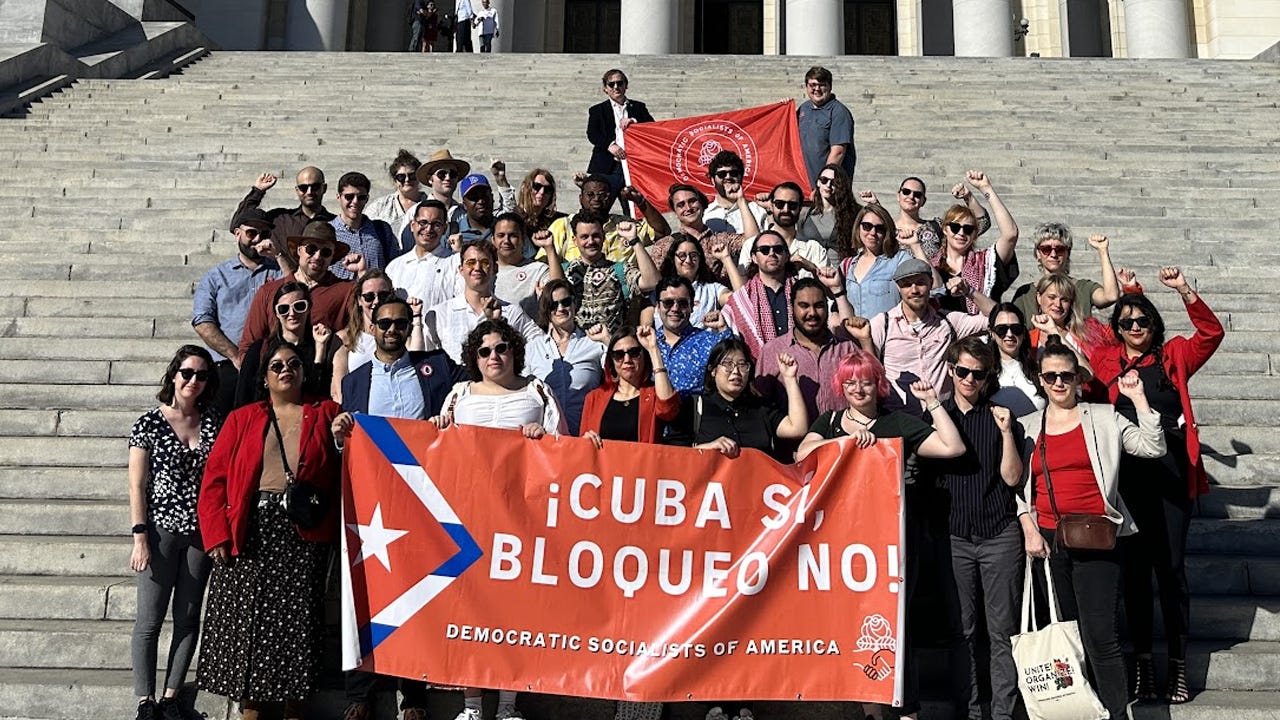
The American people are being confronted with evidence of a foreign influence operation that reaches far beyond conventional espionage, diplomatic maneuvering, or propaganda. The communist dictatorship in Cuba has spent decades cultivating relationships with Marxist American radicals, welcoming activists to Havana, immersing them in revolutionary ideology, and helping build political networks capable of mobilizing demonstrations and disorder inside the United States. Recent reporting in The New York Post concerning the scope of these activities should make every patriotic American demand an immediate and comprehensive investigation. When a hostile foreign regime trains, finances, encourages, or assists political activists operating on American soil that activity cannot be dismissed as cultural exchange, humanitarian solidarity, or constitutionally protected dissent. It must be examined as a potential national security threat.
As the husband of a Cuban/American woman, my wife Nydia, I do not view the crimes of the Castro regime as an abstract ideological debate. I have seen the lasting pain that communism inflicted upon Cuban families who lost their homes, businesses, property, freedom, and homeland to a brutal dictatorship. The Cuban exile community understands what many comfortable American radicals refuse to acknowledge. Communism is not an intellectual fashion, a romantic rebellion, or an academic theory discussed safely in a university seminar. It is a system of coercion that survives through censorship, confiscation, imprisonment, surveillance, intimidation, and political violence. The same regime that has denied fundamental freedoms to the Cuban people has no legitimate right to lecture the United States of America about democracy, civil liberties, or political persecution.
The latest allegations concerning Cuban support for American radicalism fit a pattern that reaches back generations. For decades trips to Cuba have functioned as a form of political education for activists who admire revolutionary movements and despise the constitutional order of the United States. The Venceremos Brigade brought Americans to the island under the banner of solidarity, agricultural work, and opposition to United States policy. Participants were exposed to the mythology of the Cuban revolution and presented with a carefully manufactured image of communist society. The dictatorship portrayed itself as heroic, egalitarian, and anti imperialist while concealing the political prisoners, secret police, rationing, poverty, censorship, and desperation that defined daily life for ordinary Cubans.
Some Americans who entered this ideological pipeline later became involved in militant organizations, including elements associated with the terror organization the Weather Underground in the late 1960’s and early 1970’s as well as other revolutionary movements of the era. And let’s not forget that Barack Hussein Obama launched his political career from the living room of Weather Underground leader Bill Ayers. That history matters because political extremism does not develop in a vacuum. It is nourished by organizations, money, training, propaganda, personal connections, and the moral permission to regard one’s own country as irredeemably evil. Havana offered American radicals a foreign sanctuary where hostility toward the United States was not merely tolerated but celebrated. The names and organizations have changed over the decades but the underlying process of ideological cultivation appears to have survived.
The danger becomes especially clear when radical rhetoric is accompanied by organized intimidation, attacks on government facilities, assaults on law enforcement personnel, or attempts to interfere with military and immigration operations. A former United States Army soldier reportedly set gasoline ablaze outside an Immigration and Customs Enforcement (ICE) office in New York. No publicly established connection between that incident and the Cuban government has been announced, and responsible investigators must follow the evidence wherever it leads. Nevertheless, such violence demonstrates why foreign support for extremist political networks must be treated seriously. When activists are taught to regard immigration officers, police, military personnel, and federal institutions as illegitimate enemies, incendiary language can become incendiary action and carry over to the mainstream public, including individuals who incite and inflict serious damage and violence.
The United States must distinguish clearly between peaceful protest, which is protected by the Constitution, and foreign directed or foreign financed operations intended to disrupt government functions or encourage political violence. Americans possess an unquestioned right to criticize their government, march in the streets, organize political movements, and advocate even foolish or destructive ideas. They do not possess a right to conceal work performed on behalf of hostile foreign powers, evade registration requirements, violate sanctions, destroy property, threaten public officials, or assist foreign regimes in destabilizing the country. The First Amendment protects political expression. It does not provide immunity for espionage, covert foreign agency, material support, arson, conspiracy, or terrorism.
Several prominent activists and political figures have developed associations with Cuban organizations or participated in delegations to Havana. Such travel does not by itself prove criminal activity but it does justify scrutiny when it is coordinated, subsidized, or politically directed by organizations linked to foreign governments or foreign funding. Calla Walsh, formerly associated with the National Network on Cuba, later appeared in Iran and participated in rhetoric hostile to the United States. Los Angeles Mayor Karen Bass traveled to Cuba as a young activist and later referred to Fidel Castro as “Comandante en Jefe” following his death, language that understandably outraged Cubans who knew Castro not as a romantic revolutionary but as the architect of their oppression and the destruction of their homeland.
The participation of younger activists is equally troubling because it suggests that the ideological pipeline has been renewed for another generation. Isra Hirsi, the daughter of Representative Ilhan Omar, traveled to Havana in connection with a trip reportedly arranged with assistance from the People’s Forum. Democratic Socialists of America (DSA) members have also traveled to Cuba and met with communist officials. Online political personality Hasan Piker reportedly joined one such delegation. These visits should not be treated automatically as evidence of crimes, but neither should they be waved away as ordinary tourism when participants return to the United States and promote political narratives aligned with the interests of hostile or authoritarian regimes.
The purpose of an influence operation is not always to issue direct orders. A foreign government can achieve considerable results by cultivating sympathetic Americans, offering access and prestige, reinforcing ideological commitments, creating personal loyalties, connecting organizations, and providing a heroic revolutionary narrative that activists carry home. The most effective foreign assets may not think of themselves as assets at all. They may believe sincerely that they are advancing justice while repeating propaganda designed by governments that imprison dissidents and deny their own citizens the rights these activists exploit in the United States.
Financial networks supporting radical organizations require the same rigorous examination. Neville Roy Singham has been identified in extensive reporting as a wealthy benefactor connected to organizations including the People’s Forum. Code Pink and other activist groups have also faced questions concerning funding, affiliations, and advocacy that frequently benefits governments hostile to American interests. James “Fergie” Chambers has likewise drawn attention from federal authorities. Allegations concerning these individuals must be tested through lawful investigation, subpoenas, financial records, sworn testimony, and judicial proceedings. The point is not to declare guilt by association. The point is to determine whether money originating with foreign nationals, foreign interests, or foreign governments has been used to influence American political activity without the transparency required by law.
Congress has both the authority and the duty to investigate. The House Foreign Affairs Committee, the House Judiciary Committee, the House Oversight Committee, and the appropriate Senate committees should obtain the complete government reporting concerning Cuban influence operations. They should subpoena relevant financial records, communications, travel documentation, donor information, organizational correspondence, and testimony from the individuals involved. Witnesses should be placed under oath and required to explain who paid for their travel, whom they met, what instructions or political guidance they received, and whether they maintained continuing relationships with Cuban officials or intermediaries after returning to the United States.
The Department of Justice (DOJ) must also determine whether any participants were required to register under the Foreign Agents Registration Act (FARA). FARA is not intended to punish unpopular opinions, it is intended to ensure that Americans know when political activity is being conducted at the request, direction, control, or financial support of a foreign principal. Selective enforcement has damaged public confidence in the law. If FARA is invoked aggressively against some defendants while ignored when leftist organizations advance the interests of communist governments, then the law becomes another instrument of political favoritism. The standard must be clear, consistent, and applied without regard to ideology.
The Treasury Department should trace financial transfers, identify intermediary organizations, and enforce sanctions against prohibited transactions involving Cuba and its allies. The Internal Revenue Service (IRS) should review whether tax exempt organizations are operating within the purposes represented in their filings and whether charitable structures have been used to conceal partisan, foreign directed, or unlawful political activity. Tax exemption is not an entitlement. It is a public privilege granted under specific conditions, and organizations that abuse that privilege should lose it after due process and a proper evidentiary finding.
Congress should also require greater disclosure of substantial foreign sourced donations to nonprofit organizations engaged in American political advocacy. Current disclosure rules leave serious gaps that allow money to move through foundations, fiscal sponsors, shell entities, donor advised structures, and affiliated organizations before reaching the groups that conduct demonstrations and political campaigns. Transparency would not prohibit lawful speech or association. It would allow the American people to understand who is financing movements that seek to influence public policy, disrupt government operations, and reshape the country’s political institutions.
Cuban dictator Miguel Díaz Canel has reportedly complained about a new and more dangerous version of McCarthyism in the United States. His protest should be regarded as confirmation that scrutiny is overdue. The American left has spent decades using the word McCarthyism as a weapon against anyone willing to investigate communist penetration, subversion, and covert influence. That caricature has obscured the historical record. Senator Joseph McCarthy was not wrong to recognize that communists and Soviet sympathizers had entered influential American institutions. Declassified intelligence, Soviet archives, and subsequent historical research demonstrated that communist espionage and penetration were genuine threats, not inventions of paranoid conservatives.
Alger Hiss was not an innocent victim of anti communist hysteria. The Rosenberg espionage network was not a conservative fantasy. Soviet intelligence did recruit Americans, penetrate government institutions, steal secrets, manipulate political organizations, and exploit fellow travelers who considered themselves morally superior to the country they betrayed. The lesson is not that every dissenter is a spy. The lesson is that dismissing all investigations as hysteria provides ideal protection for genuine foreign agents and covert influence networks.
The phrase McCarthyism is now deployed whenever investigators approach organizations favored by the political left. It is intended to end the inquiry before the evidence can be examined. That tactic must no longer succeed. Asking who funds an organization is not persecution. Requiring foreign agents to register is not censorship. Investigating coordinated relationships with hostile governments is not authoritarianism. Enforcing laws against violence, arson, sanctions evasion, undisclosed foreign lobbying, and material support is not an attack on democracy. It is a basic function of a sovereign republic.
The hypocrisy of the Cuban regime is staggering. While its rulers complain about American investigations, the Cuban people continue to endure blackouts, water shortages, food scarcity, inadequate medical supplies, political repression, and the denial of free elections. Cuban dissidents cannot organize openly, establish independent political parties, criticize the dictatorship freely, or rely upon an impartial justice system. American radicals travel to Havana, praise the revolution, pose for photographs, and return home without experiencing the daily fear imposed upon Cubans who dare to challenge the Communist Party.
My wife Nydia and I and countless members of the Cuban exile community know the truth about this regime because their families paid the price. They remember confiscated property, destroyed businesses, divided families, political prisons, firing squads, and dangerous journeys into exile. Their testimony carries greater moral weight than the slogans of privileged American activists who visit Havana for carefully managed political theater. The Cuban people do not need lectures from American socialists who romanticize their oppressors. They need freedom, representative government, private property, religious liberty, uncensored information, and the right to determine their own future.
President Donald Trump has correctly restored anticommunism to the center of American foreign policy. His administration should intensify sanctions enforcement, expose Cuban intelligence and influence operations, support democratic dissidents, and deny legitimacy to organizations that function as propaganda vehicles for Havana. The administration should publish as much evidence as national security permits so the American people can evaluate the scope of the threat. Secrecy protects the foreign influence network. Disclosure, lawful investigation, and prosecution protect the republic.
The United States must not repeat the mistakes of earlier administrations that treated engagement with Cuba as an end in itself. Concessions were offered in exchange for promises of reform that never materialized. The dictatorship gained money, diplomatic recognition, commercial opportunities, and renewed international standing while continuing to imprison dissidents and suppress political opposition. A regime that will not permit freedom at home should not be allowed to cultivate subversion abroad without consequences.
Cuba must be held accountable for any role it has played in training, financing, directing, or encouraging radical operations inside the United States. Individuals and organizations involved must receive due process, but due process begins with investigation rather than denial. Evidence must be obtained, witnesses questioned, financial networks traced, and applicable laws enforced. Those found to have engaged only in lawful political advocacy should face no punishment. Those found to have concealed foreign agency, violated sanctions, financed violence, or conspired to attack American institutions should be prosecuted fully.
The threat of leftist political violence will grow if public officials continue to ignore the ideological and financial infrastructure behind it. Revolutionary movements do not appear spontaneously. They are organized, funded, trained, promoted, and protected by networks that understand how to exploit American tolerance while serving forces that despise American freedom. Cuba has spent decades presenting itself as the headquarters of resistance to the United States. The time has come to take that declaration seriously.
Communism never disappeared. It changed its language, modernized its propaganda, and recruited new advocates, but its contempt for private property, national sovereignty, religious liberty, and constitutional government remains intact. America must expose the network, enforce the law, protect peaceful political expression, and crush foreign supported violence before it becomes a larger and deadlier threat. The Cuban dictatorship has enjoyed impunity for far too long. It is time for Havana and its collaborators to pay the lawful price for any attempt to incubate extremism and terror on American soil.
The left screams “McCarthyism” because the word is designed to stop the investigation before evidence appears. It is a shield for the Red network. But asking financial questions is not censorship. Requiring FARA compliance is not fascism. Investigating foreign influence is not persecution. Cuba’s dictatorship crushes dissidents at home while privileged American radicals visit Havana, pose for revolutionary theater, and return to undermine the freest country on earth. Congress, DOJ, Treasury, and IRS should follow the money, subpoena the records, expose the networks, and prosecute real crimes. Communism did not disappear. It rebranded and recruited.
Thank you for this article. Your own family opens the door to an up close scrutiny most of us don't have access to. Virtually no one is talking about this enormous issue. We are bankrupting America while enabling the destruction of our own culture, government, and society. Cuba, Mexico, many Latin and South American countries, and the Catholic Church are all deeply invested in destroying American freedom, or at least what's left of it. Thanks again.