


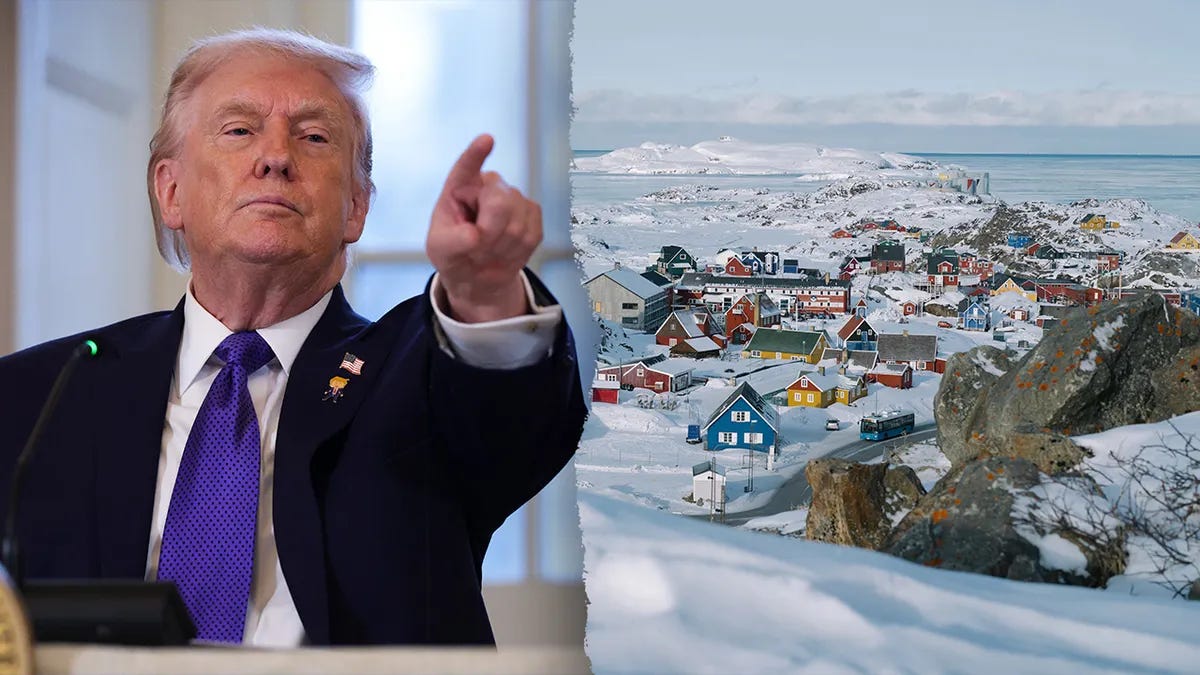
Many Americans are baffled as to why the United States must acquire Greenland. It is because President Trump realizes that we cannot permit the Arctic to become an enemy highway, and the American people deserve to understand, in plain language, why this matters right now. Greenland is not a novelty. It is not a Scandinavian snow globe. It is not a quirky Arctic postcard full of colorful houses, seal soup, and midnight sun selfies. Greenland is the most strategically valuable island on Earth, and if America treats it like a trivia question, we will wake up one day to find that Russia and China have treated it like a military objective.
For decades, Greenland has been discussed as if it were a distant curiosity. But Greenland is the crown jewel of the Arctic, and the Arctic is rapidly becoming the most dangerous arena of geopolitical competition on the planet. Shipping routes are evolving. Military postures are shifting. Critical resources are being hunted like trophies. Power is moving north, and America cannot afford to be last to the battlefield.
Greenland is the world’s largest island that is not its own continent, spanning more than 2.16 million square kilometers (or 1.34 million miles) it dwarfs most countries. It is not a small territory, but an enormous strategic platform hovering over the future of the West.
And Greenland is not just big, it is positioned like a dagger pointed at the transatlantic lifeline. Whoever controls Greenland can influence the approaches between North America and Europe, monitor and potentially disrupt movement across the Arctic, gain the high ground in a world where high ground no longer means hills and mountains; it means radar, satellites, missile warning, and the ability to see threats before they reach our shores. This is not academic. This is existential.
America already understands Greenland’s military value, which is why the United States operates Pituffik Space Base on the island, formerly known as Thule Air Base. This installation is not a tourist attraction. It is part of the backbone of American early warning capabilities, space surveillance, and missile defense posture. It exists because geography is destiny, and Greenland is one of the most decisive pieces of geography on Earth.
Missiles, bombers, submarines, and long range aircraft do not care about diplomatic niceties. They care about routes, distance, positioning, and reaction time. Greenland sits astride the shortest lines between North America and Eurasia. If Russia were to escalate, Greenland is where you would see it coming. If China expands into the Arctic Greenland is where you track it. If America intends to remain secure in an age of fast moving threats and shrinking response windows, Greenland becomes the lock on the northern door.
The Arctic is no longer a frozen wilderness at the edge of the map. It is becoming an active corridor, a shipping frontier, and a militarized arena. It is becoming, in real terms, a highway for influence, power projection, and strategic encroachment.
Greenland is also a resource vault and this is where the discussion becomes even more urgent. Modern power is built on critical minerals. Not slogans. Not speeches. Not virtue signaling. Minerals.
The world that runs on satellites, missiles, advanced radar, batteries, aircraft, communications systems, and next generation manufacturing is the world that depends on rare earth elements and strategic industrial inputs. Greenland is known to contain substantial deposits of critical and strategic minerals, including rare earth elements such as neodymium, praseodymium, dysprosium, and terbium. These are essential for high performance magnets used in advanced defense systems, radar, electric motors, and aerospace technology.
Greenland also holds uranium, one of the most strategically sensitive resources on Earth, vital to nuclear energy and closely tied to national security realities.
Greenland contains zinc, critical for alloys, infrastructure, and defense manufacturing. It contains nickel, a major input for high strength steel and modern battery technology. It contains copper, essential for power grids, weapons systems, electronics, and industrial production. It contains iron ore, one of the foundational industrial minerals for manufacturing at scale. It contains titanium, prized in aerospace and defense engineering because it is strong, light, and indispensable. It contains gold, valuable not only as a commodity but as a signal of resource wealth. It contains graphite, vital for batteries and advanced industrial supply chains.
These are not optional resources. These are the building blocks of modern civilization and modern deterrence. A nation that cannot secure its inputs is not sovereign. It is dependent. It is exposed. It is weak.
If America secures Greenland, America secures leverage over the next century of industrial and military competition. If America does not, then China, Russia, or their proxies will attempt to dominate Greenland’s mineral future and position themselves to choke America’s supply chains whenever it suits them.
Now consider the uncomfortable truth about Denmark. Denmark cannot defend Greenland in any meaningful way against a determined adversary. Denmark can administer Greenland. Denmark can subsidize Greenland. Denmark can wrap itself in a veneer of sovereignty. But Denmark cannot protect Greenland as the Arctic heats up into a zone of confrontation.
So what do the Danes gain from Greenland? They gain prestige. They gain global relevance beyond what their size and military capacity would otherwise justify. They gain influence in Arctic affairs. They gain a seat at strategic tables. They gain a megaphone they did not build with their own power. And Denmark also benefits from a world where America quietly carries much of the security burden, because the United States cannot afford Greenland falling into hostile hands. That is a comfortable arrangement for Denmark. It is not a safe arrangement for America.
Greenland itself receives substantial financial support from Denmark, and that subsidy relationship has long shaped the pace and complexity of Greenland’s independence debate. Many Greenlanders want independence in principle, but economic realities matter. Independence is a noble aspiration. Economic instability is a nightmare.
Do Greenlanders want to remain Danish? Some do, especially for stability and support. Do Greenlanders want independence? Many do, but they want it without becoming vulnerable. Do Greenlanders want to be American? Generally, and surprisingly, no. Greenlanders have their own identity, and public sentiment has often resisted outright American annexation.
But here is the part Washington cannot afford to ignore. Greenland’s future cannot be allowed to become a vacuum. Vacuums get filled. They do not get filled by friendly forces. They get filled by whoever moves fastest, spends the most, and asks the fewest moral questions. That means hostile influence disguised as investment. That means strategic infiltration dressed up as economic development. That means foreign penetration that begins with contracts and ends with control.
Recent reporting has sharpened this urgency. President Trump, furious over what he describes as a Nobel Peace Prize snub, said he no longer feels obligated to think purely in terms of peace and has framed Greenland as a direct American interest. He has argued that Denmark has long failed to meet the demands of Arctic security and that the United States may need to act in its own interests, even warning of economic pressure against European nations tied to the dispute. This is not a casual remark. It is a warning shot. It signals that the era of polite patience is ending and the era of strategic necessity has begun.
Other reporting has highlighted Greenlanders voicing resentment toward Danish rule and accusing Denmark of stealing their future. That matters because it reveals internal tension, historical grievances, and instability under the surface. And instability, in geopolitics, is an invitation for predators.
Now let’s speak of Greenland’s quirks, because they are part of its charm and part of its reality.
In many towns, more people own boats than cars. Why? Because there are few roads between settlements, and the icy terrain makes conventional travel impractical. Greenland is not a country you drive across. It is a place you navigate like an archipelago, by water and by necessity.
Greenland has almost no traffic lights, with some sources claiming only one or a handful in Nuuk, making it one of the least traffic signal saturated places on Earth. That fact is adorable, almost comical. But it also reflects how small and concentrated Greenland’s urban life is compared to its enormous strategic footprint.
The sun does not set for months in summer. From late May to late July, Greenland experiences the midnight sun, where daylight runs around the clock for roughly two months. Endless day. Endless visibility. Endless exposure. Endless light. An environment where nature itself feels alien to the human body.
Greenland’s national dish is not fine dining, it is survival cuisine. Soups and stews made from seal, whale, reindeer, or seabirds reflect Inuit traditions forged in a punishing climate. This is a culture that learned to endure when most of the world would collapse.
The Vikings arrived around the year 1000, built farms and churches, lasted nearly 500 years, and then vanished by the 15th century. Their fate remains one of history’s great Arctic mysteries. Greenland does not merely host history. It swallows it.
Nuuk, the capital, is surprisingly vibrant and funky for such a remote place. It is small, colorful, and modern, with cafes, museums, fashion boutiques, and a Nordic character that feels almost surreal against the Arctic backdrop. It is the kind of city you do not expect to find in a place most people imagine as a barren white expanse.
Even the dogs have politics in Greenland. Sled dogs are banned in Nuuk to prevent conflicts with people and traffic, even though sled dogs remain iconic and essential in smaller northern towns.
And here is the geological fact that should make every military planner sit up straight. Greenland’s massive ice sheet presses the land down so heavily that if all the ice melted, huge parts would be below sea level. Greenland would resemble a ring of land around a giant inland sea, like a strange polar atoll. That is how powerful the ice is. That is how extreme Greenland is. It is a place shaped by forces most of humanity never has to confront.
Greenland is weird. It is wonderful. It is unexpected. But it is also deadly serious. This is why the United States must act with urgency. Greenland is not a Danish curiosity. Greenland is an American necessity.
President Trump is correct; we cannot allow foreign adversaries to dominate strategic mineral supplies that will determine the outcome of future conflicts. We cannot surrender the most valuable forward platform on Earth for missile warning, space surveillance, and northern defense. We cannot sit back and pretend the Arctic will remain peaceful simply because we wish it were so.
What happens if America fails to secure Greenland? America becomes vulnerable. Europe becomes vulnerable. NATO becomes divided. The North Atlantic becomes exposed. And the world becomes less safe. This is not fearmongering. This is realism.
The future of security will be decided by those who control strategic geography and strategic materials. Greenland is both. It is the keystone.
And if the United States does not seize this moment, we will face a far darker moment later, when our enemies have already positioned themselves above our heads and at the gates of the West.
The Inuits of Greenland are related to the Inuits of Canada.
I hope they will get their independence from Denmark, which has treated them badly and with racism.
I hope the independent Inuit Greenlanders will realize their new best friend is Trump and the USA.
I recommend watching the last and latest Danish series "Borgen" which is about Greenland and the attempt of Russia and China to control it and its resources.
I flew with the U.S. Naval Air.. Patrol Squadron 49, out of Thule, Greenland in 1967… Quite the experience flying in P3A Orion aircraft, at 500 feet between 12,000 feet mountains on both sides in gorges 2-3 miles wide, with our forward radar down… with an ex jet jockey as our plane captain, nearly barely escaping a crash against the sides of mountains/covered in ice/snow.. .. our plane captain took the aircraft and flew up and in a cork screw patten staying within the appropriate position, that was safe until we reached a height over 10,000 feet and above the mountains. I still remember the g-forces against gravity … the closest crash I ever experienced, in my 3 years of flying .. quit the experience!