


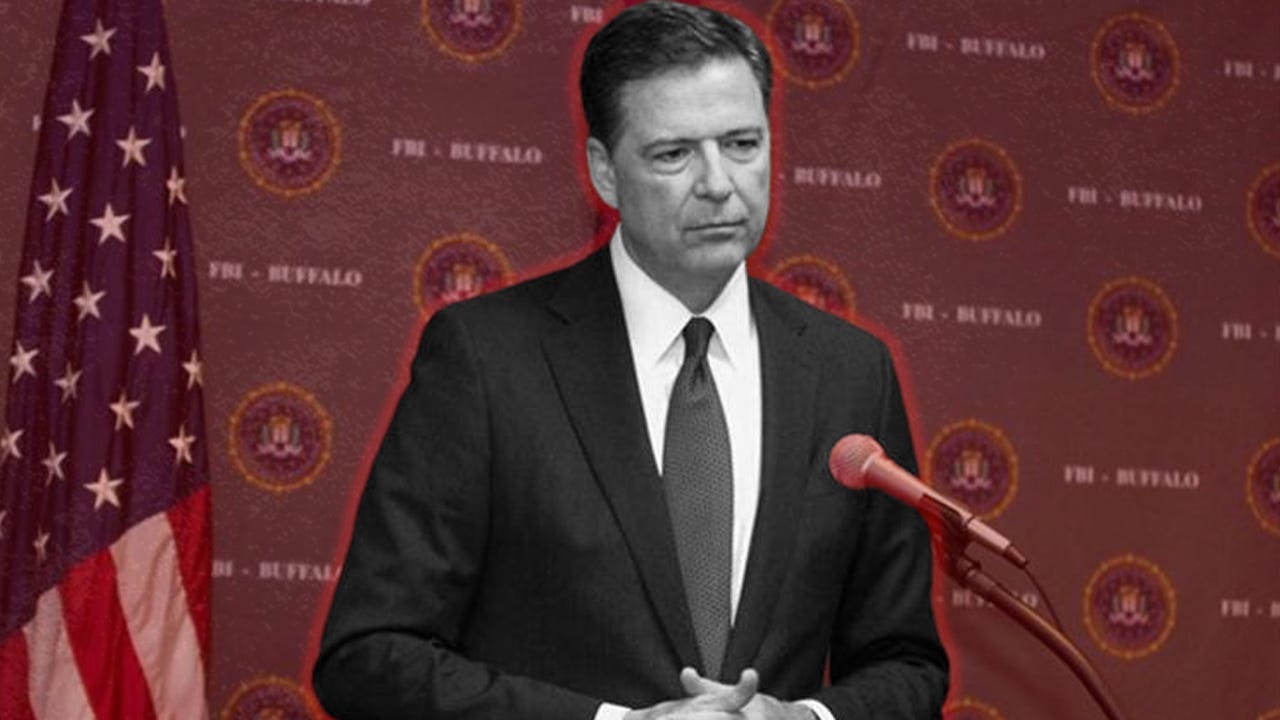
James Comey now stands in precisely the cold spotlight of the accused, the indicted, and hopefully the soon-to-be convicted former FBI Director. The man who spent years cultivating the image of a granite hewn moral sentinel, has been indicted for a second time by a federal grand jury.
This latest case reportedly arises from the now notorious Instagram photograph in which seashells were arranged to read “86 47,” accompanied by a breezy caption about a beach walk and a curious shell formation.
Millions of Americans instantly understood the implication. “86” is common slang for remove, eject, or eliminate. “47” refers to President Donald Trump, the 47th President of the United States. The meaning was plain enough to any citizen with common sense and a pulse.
Once public outrage erupted, the post vanished. Then came the familiar Comey refrain: misunderstanding, innocence, surprise, lofty opposition to violence, and wounded confusion that anyone would interpret the message as threatening. It was the bureaucrat’s version of being caught with smoke pouring from the kitchen while insisting no one can prove who lit the stove.
But James Comey is no naïve retiree stumbling through the language of the modern age. He is a former United States Attorney, former Deputy Attorney General, former FBI Director, and one of the most media conscious government officials of the last generation. He understands symbolism. He understands coded language. He understands how political rhetoric migrates through television screens, social media feeds, and the fever swamps of unstable minds. That is exactly why this matter is serious.
America has endured repeated assassination attempts, political violence, and a coarsening culture in which extremists increasingly mistake theatrical menace for civic engagement. In such an environment, a former FBI director does not enjoy the luxury of playing coy with numerals and then pleading innocence when the public notices. He knew exactly what he was doing, he did it with intent, and he knew better.
This indictment is also significant because it marks Comey’s second trip into the criminal dock in roughly six months. His first indictment, brought in 2025, involved allegations of false statements to Congress and obstruction tied to his Senate testimony concerning matters connected to the Clinton email investigation era. That case collapsed amid procedural irregularities, questions regarding prosecutorial authority, and what the court reportedly described as government misconduct and investigative missteps. Even there, the pattern was revealing. Wherever James Comey appears, confusion seems to follow like exhaust from a badly tuned engine.
For years Comey postured as the nation’s ethical headmaster while leaving a wake of institutional wreckage. He inserted himself into the 2016 election by publicly castigating Hillary Clinton’s conduct while declining prosecution. He then briefly revived the Clinton email matter days before the vote. He presided over the opening phase of Crossfire Hurricane, the now infamous Russia collusion saga that convulsed the country, relied in part on poisoned opposition research, and became one of the most disgraceful intelligence episodes in modern American history.
He leaked memoranda of private presidential conversations through intermediaries. He monetized grievance through books, speeches, and television appearances. He transformed the office of FBI director into a vanity platform.
Always the sermon. Always the spotlight. Always the self regard. Now the old magistrate finds himself judged. The legal standard in this new case is substantial. Prosecutors reportedly must show that Comey subjectively understood the message would be perceived as a threat. Courts do not lightly criminalize speech, nor should they. Political expression, even vulgar political expression, occupies a protected place in our republic. But ambiguity deliberately employed by a sophisticated actor is not the same thing as innocence. A man who spends a lifetime communicating through implication cannot suddenly claim illiteracy in implication.
That is the central irony of the Comey saga. He built his career in the gray areas between what was said and what was meant, between what could be proven and what could be insinuated, between law and theater. He weaponized suggestion when it benefited him. He now asks the nation to believe suggestion is meaningless when it implicates him. No sale.
Whether prosecutors prevail is for the courts. Whether a jury convicts is another matter entirely. But politically and morally, this indictment already carries force. It reminds the American people that titles do not confer sainthood, media adulation does not erase misconduct, and bureaucratic pedigree does not place one above scrutiny.
James Comey once moved through Washington as if carved from marble. In truth he was always fashioned from something much more brittle: vanity, ambition, and the intoxicating belief that rules were for other people. Eventually, every brittle monument cracks.
That slime-bucket belongs in the Supermax showers and the pivotal chapter in his next memoirs should be titled, “I was the bitch of cell-block C”.
Comey knew exactly what he was doing. This is not some confused retiree arranging beach shells after pickleball. This is a former FBI director, prosecutor, media performer, and professional insinuator who understands symbols, coded language, and political temperature better than almost anyone. He built a career in the gray zone—suggest, imply, leak, posture, then retreat into sanctimony. Now the gray zone has him by the throat. Whether the government proves the criminal case is one question. But morally? Politically? The verdict is already in. Comey thought rules were for peasants and targets. Now he gets to learn what it feels like to be a target.