


There are moments in history when Providence appears to suspend time itself. The sun still rises. Men continue their labors. Horses traverse muddy streets. Church bells toll as they always have. Yet beneath the familiar rhythms of ordinary life, eternity quietly turns a page. July 3, 1776 was such a day. It was the last full day before a small assembly of imperfect yet extraordinary men would forever alter the destiny of mankind by proclaiming that liberty is not a favor bestowed by earthly rulers, but a sacred inheritance granted by Almighty God.
We rightly celebrate July 4 as the birthday of the United States. Yet it was on July 3, 1776 that the Founders stood together in solemn anticipation, keenly aware that they were about to sever the mightiest political bond on earth. The following day would immortalize their words. July 3 tested their resolve.
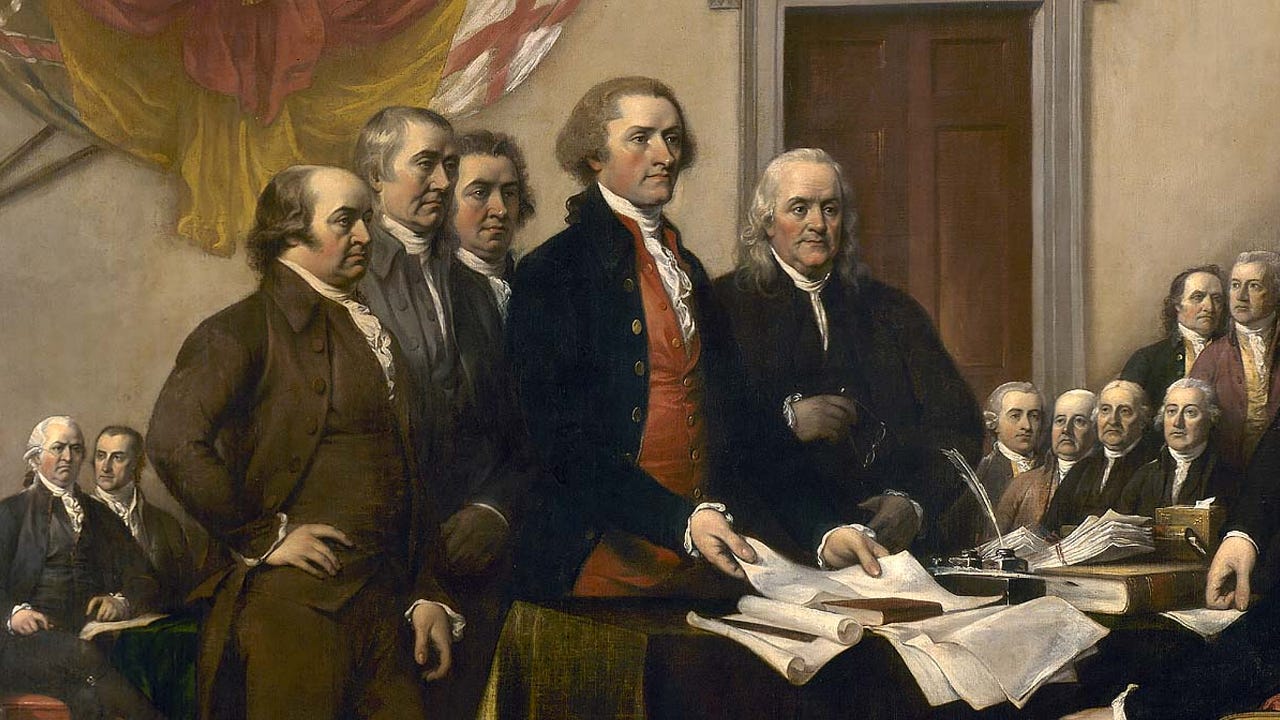
Inside the sweltering chambers of Independence Hall, the delegates of the Second Continental Congress resumed their painstaking examination of the Declaration of Independence principally drafted by Thomas Jefferson. The previous day, Congress had already adopted the Lee Resolution, declaring that the colonies were, and by right ought to be, free and independent states. Independence had been resolved. Now it had to be explained before the tribunal of history and before the judgment of Heaven.
The delegates transformed themselves into a committee of the whole and scrutinized Jefferson’s draft line by line. Every sentence bore tremendous consequence. Every phrase would echo through generations yet unborn. They ultimately made approximately 86 revisions, reducing the length of the Declaration by nearly one quarter while preserving its immortal principles. They did not finish their work that day. As evening approached, they adjourned with the intention of returning on July 4, 1776 to complete the final edits and adopt the document that would forever define the American experiment.
Jefferson watched as portions of his magnificent prose yielded to the necessities of unanimity. His denunciation of the British Crown’s role in sustaining the transatlantic slave trade was removed to preserve the fragile union among the colonies. It was an imperfect compromise, but history repeatedly teaches that nations are often born amid human frailty while aspiring toward divine truth. The Founders were not saints. They were statesmen striving to erect a republic worthy of future generations who might continue perfecting the noble principles they proclaimed.
Presiding over these extraordinary deliberations was John Hancock, while John Adams remained the Revolution’s indefatigable champion. On July 3, Adams wrote one of the most remarkable letters in American history to his beloved wife, Abigail Adams. Overflowing with hope despite the gathering storm, Adams predicted that the great act of independence would one day be commemorated with parades, bells, bonfires, fireworks, and celebrations from one end of the continent to the other. His prediction proved gloriously correct, even if history ultimately attached those festivities to July 4 rather than July 2, 1776 the date Congress formally voted for independence. Adams also reflected upon the hardships already endured, lamenting that independence had not been declared sooner, believing earlier resolve might have spared the colonies painful military reverses, including the tragic Canadian campaign devastated by smallpox.
While these deliberations unfolded in Philadelphia, the tempest of war gathered with alarming speed. Across the waters of New York Harbor, an immense British armada under General William Howe and Admiral Richard Howe assembled near Staten Island in New York and Sandy Hook in New Jersey. Tens of thousands of British and Hessian soldiers prepared to descend upon the colonies with overwhelming force. The British Empire believed this rebellion could be extinguished through superior numbers, disciplined armies, and the unrivaled power of the Royal Navy.
Standing in their path was General George Washington and a Continental Army whose greatest abundance was not muskets or cannon but faith. His soldiers lacked sufficient clothing, ammunition, provisions, and reliable pay. Disease stalked their encampments more relentlessly than enemy fire. Many marched barefoot. Many had left wives, children, farms, and livelihoods behind. Yet they possessed something no empire could manufacture and no monarch could command. They believed they were defending not merely territory, but a truth.
Throughout the 13 colonies ordinary Americans lived through one of the most uncertain evenings in their lives. Farmers gathered harvests while wondering whether British troops would soon trample their fields. Blacksmiths forged horseshoes, wagon wheels, and musket parts destined for both peaceful labor and war. Merchants struggled beneath the weight of economic uncertainty. Ministers ascended pulpits calling their congregations to prayer, reminding them that earthly kingdoms rise and fall, but the sovereignty of Almighty God endures forever. Mothers embraced sons preparing for military service, uncertain whether those embraces would be their last. Fathers quietly contemplated whether the liberty they sought would be purchased with their own blood or that of their children.
The delegates gathered in Philadelphia understood the fearful magnitude of what awaited them. They were not composing an academic essay destined for quiet libraries. They were signing a public indictment against the most formidable empire on earth. Should the Revolution fail, they faced execution for treason, confiscation of their property, and ruin for their families. They knowingly placed their fortunes, their reputations, their homes, and their very lives upon the altar of liberty.
Yet their confidence rested not in themselves. The Declaration they refined on July 3, 1776 did not proclaim the sovereignty of Parliament. It did not exalt the authority of kings. It appealed instead to the “Laws of Nature and of Nature’s God.” It acknowledged that human rights are not gifts from governments but endowments bestowed by the Creator Himself. It concluded with “a firm reliance on the protection of divine Providence” affirming that there exists a Sovereign infinitely higher than any earthly monarch. The Founders understood that King George III ruled an empire, but only Almighty God ruled the universe. Their allegiance ultimately belonged not to a crown fashioned by men, but to the eternal King whose justice transcends every throne built by human hands.
As darkness settled over Philadelphia on that quiet July evening, candles flickered across scattered drafts, ink stained quills, and well worn Bibles. The streets grew still, but the hearts of the delegates surely did not. Many must have prayed. Many undoubtedly contemplated their families. Some almost certainly wondered whether they would live long enough to witness the outcome of the cause they had embraced. None could foresee Yorktown. None could imagine a Constitution. None could envision an America stretching from sea to shining sea or becoming a beacon of liberty for people around the globe.
They knew only that the next day they would entrust their futures to God and to history.
The world remembers July 4, 1776 because liberty was proclaimed. We should also remember July 3, 1777 because liberty was prayerfully prepared. Before there could be celebration, there was contemplation. Before there could be triumph, there was sacrifice. Before there could be a republic, there were men who humbled themselves before the Sovereign of Heaven and accepted that freedom would demand everything they possessed.
Every generation inherits the blessings purchased by those who came before. Every generation must also decide whether it possesses the same courage to preserve them. The quiet hours of July 3, 1776 remind us that nations are not ultimately sustained by wealth, armies, or political power. They endure only so long as their people acknowledge that true liberty flows not from the permission of government, but from the hand of Almighty God, the one eternal Sovereign before whom every king, every parliament, every congress, and every nation must one day bow.
The permanent political class wants Americans to treat Independence Day as a long weekend with approved slogans. Stone points back to something deeper: a Republic born from prayer, courage, sacrifice, and obedience to a higher law than government power. The Founders were imperfect men, but they understood what today’s administrative state denies: rights do not come from bureaucrats, judges, agencies, or kings. They come from Almighty God. That is why America is dangerous to every ruling-class machine. July 3 matters because before liberty was declared, it was contemplated. Before the fireworks, there was faith. Before the Republic, there was resolve.
Thank you for such an uplifting gift of your words❣️All Glory to Our God, the Holy Father of Our Lord and Savior Jesus Christ❣️AMEN and HALLELUJAH ❣️🙏God Bless you and your family and Our President, Amen 🙏