


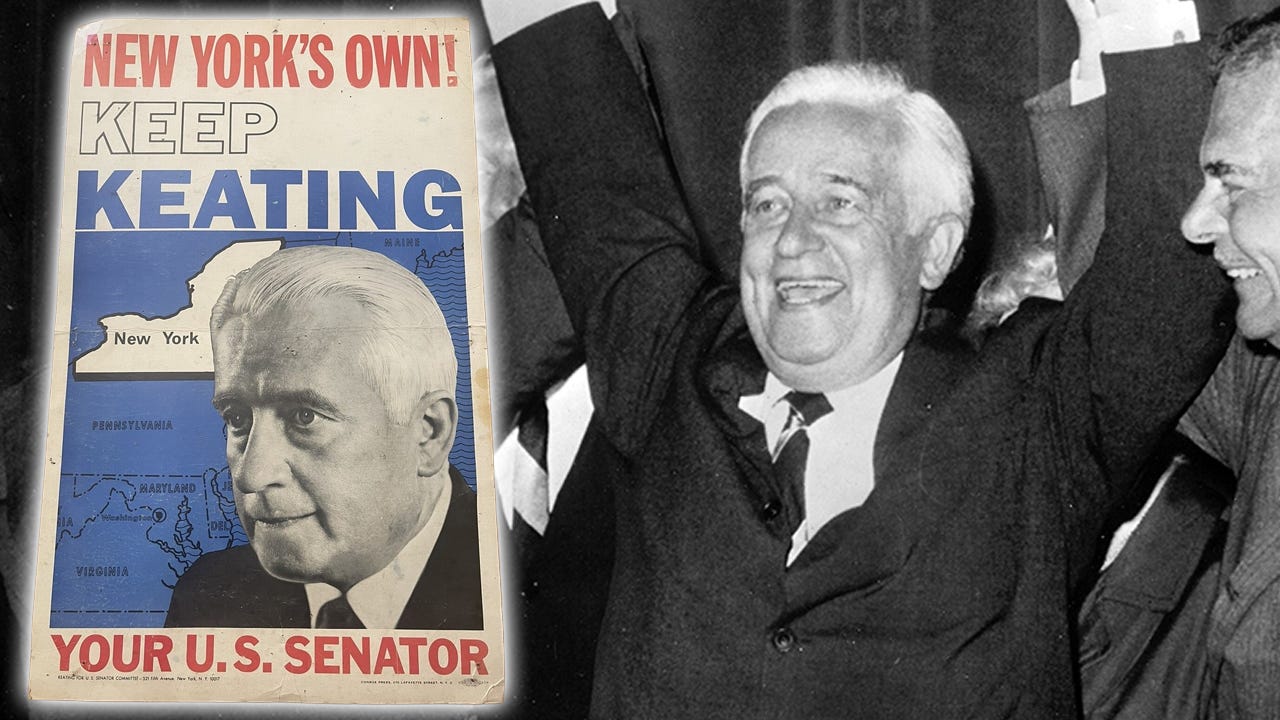
Kenneth Barnard Keating (May 18, 1900 – May 5, 1975) was an American lawyer, politician, diplomat, and judge. A moderate Republican from New York, he served six terms in the U.S. House of Representatives (1947–1959) and one term in the U.S. Senate (1959–1965). He later served as a judge on the New York Court of Appeals and as U.S. ambassador to India and then Israel.
Early Life and Military Service
Keating was born in Lima, Livingston County, New York, the son of Thomas Mosgrove Keating, a local businessman, and Louise Barnard Keating, a schoolteacher. He attended public schools and graduated from Genesee Wesleyan Seminary in Lima in 1915. He earned a bachelor’s degree from the University of Rochester in 1919 (Phi Beta Kappa) and a law degree from Harvard Law School in 1923. Admitted to the bar that year, he began practicing law in Rochester with the firm that became Harris, Beach, Keating, Wilcox, Dale and Linowitz.
During World War I he served as a sergeant in the U.S. Army. In World War II he returned to service, rising to the rank of full colonel and later being promoted to brigadier general in the reserves. He served in the China-Burma-India theater as an executive assistant involved in Lend-Lease administration and received the Legion of Merit and the Order of the British Empire.
Congressional Career
Keating was elected to the U.S. House in 1946 as a Republican representing the Rochester area (initially the 40th District, later the 38th). He served from January 3, 1947, to January 3, 1959, winning reelection with comfortable margins. In 1958 he successfully ran for the U.S. Senate seat of retiring Republican Irving Ives, defeating Democrat Frank Hogan. He served in the Senate from January 3, 1959, to January 3, 1965.
In the Senate, Keating was a liberal-to-moderate Republican on domestic issues. He supported civil rights measures and played a role in the bipartisan efforts that helped break the filibuster leading to passage of the Civil Rights Act of 1964. He also backed the 23rd Amendment (District of Columbia voting rights). On foreign policy he was a vocal critic of the Castro regime in Cuba. Most notably, in the months before the Cuban Missile Crisis he publicly warned that the Soviet Union was installing offensive missiles in Cuba, drawing on information from Cuban exiles, intelligence sources, and other channels. His warnings predated the official U.S. confirmation of the missile sites in October 1962 and heightened pressure on the Kennedy administration.
The 1964 Senate Race and the Debate Incident
Keating’s Senate career ended with his defeat in the 1964 election by Democrat Robert F. Kennedy, the former U.S. Attorney General and brother of the late President John F. Kennedy. The race was bitter. Keating accused Kennedy of “carpetbagging” after the Massachusetts native established residency in New York to run. Keating also refused to endorse the national Republican presidential nominee, Barry Goldwater, and staged a walkout of much of the New York delegation at the Republican National Convention—moves that strained relations with some conservatives while he sought to hold moderate and liberal voters in a strong Democratic year.
A notable flashpoint occurred on October 27, 1964, involving a planned television appearance that both sides framed as a debate. Keating and Kennedy had each purchased 30 minutes of airtime on WCBS-TV and were to speak from separate studios two rooms apart. Keating’s segment featured an empty chair labeled for Robert F. Kennedy, which Keating used to symbolize what he portrayed as his opponent’s refusal to debate face-to-face. Shortly before the broadcast began, Kennedy arrived outside Keating’s studio and attempted to enter and occupy the empty chair. WCBS-TV security guards barred him from the studio. Kennedy protested, stating that he was there to debate and that Senator Keating had invited him. The guards held firm, and the candidates’ segments proceeded separately. Contemporary accounts described the episode as mutual charges of campaign trickery, with each side accusing the other of “running out” on a genuine debate. The empty-chair device and the barred entry became a vivid, widely reported illustration of the personal and tactical intensity of the race.
Kennedy defeated Keating by a substantial margin (roughly 700,000 votes) amid the national Democratic landslide for Lyndon Johnson. Keating nevertheless ran well ahead of the Goldwater ticket in New York.
Later Career and Death
After leaving the Senate, Keating was elected to the New York Court of Appeals in 1965 and served until 1969. President Richard Nixon appointed him U.S. Ambassador to India, where he served from 1969 to 1972. In 1973 he became U.S. Ambassador to Israel, a post he held until his death. He died in New York City on May 5, 1975, at age 74 and was buried in Arlington National Cemetery.
Keating is remembered as an affable, publicity-conscious public servant with a long record of electoral success in New York, a key early voice on the Cuban missile threat, a supporter of civil rights legislation, and a diplomat in the Nixon and Ford eras. The 1964 campaign, including the October 27 empty-chair and studio-access confrontation with Robert F. Kennedy, remains one of the more colorful episodes of his career.
I’m glad Roger dug this one up. The empty chair gets the laugh. The election returns deserve a second look. Keating drew more than 860,000 votes beyond what Barry Goldwater got in New York, and he still lost to Kennedy.
Keating had built a reputation of his own. In one Senate term, he warned about Soviet missiles in Cuba and helped break the filibuster against the Civil Rights Act. There’s a lesson for the New York GOP: give voters a reason to remember what you did before you ask them to remember the letter next to your name.