


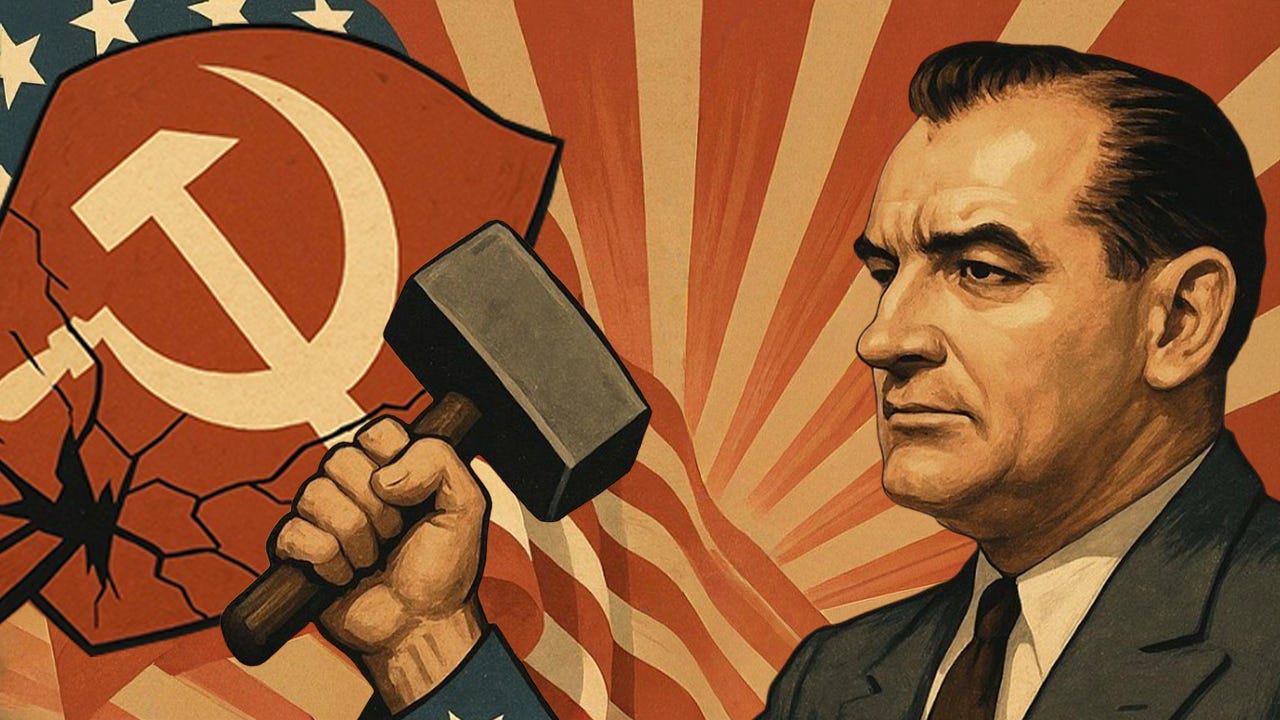
Joseph Raymond McCarthy was a United States Senator from Wisconsin who rose to national prominence in the early 1950s because he dared to confront a reality that much of the American establishment preferred to ignore. He believed communism was not merely a foreign threat but an internal one. McCarthy understood that America’s adversaries did not always arrive in military uniforms or foreign armies. Sometimes they arrived through institutions, ideas, influence networks, and political movements that slowly reshaped public opinion and government policy from within.
His fight took place during one of the most dangerous periods in modern history. Joseph Stalin controlled Eastern Europe behind the Iron Curtain. Mao Zedong had consolidated communist rule over China. The Soviet Union had successfully penetrated American institutions through espionage networks that reached into the highest levels of government. Communist parties, front organizations, propagandists, and fellow travelers operated throughout the Western world.
McCarthy did not act alone. The House Un-American Activities Committee (HUAC) and other congressional investigations emerged because elected officials from both parties viewed communist infiltration as a legitimate national security concern. Their purpose was straightforward. Identify foreign influence operations. Expose espionage networks. Investigate ideological subversion. Determine the extent to which hostile political movements had penetrated American institutions. The mythology that later emerged portrays these investigations as little more than hysteria. History tells a more complicated story.
The release of the Venona decrypts confirmed extensive Soviet espionage inside the United States government. Former communist courier Whittaker Chambers provided firsthand testimony and documentary evidence on his book “Witness”. Bella Dodd, once a prominent Communist Party organizer, later described deliberate efforts to infiltrate labor unions, educational institutions, and even religious organizations. What many dismissed as conspiracy theories often proved to have substantial factual foundations. In fact, she was quoted with stating, “When I was organizing for the Communist Party back in the 1930s, I helped place over a thousand communist men in Catholic seminaries”.
I speak with some personal knowledge of this history because I was fortunate enough to know Roy Cohn, Senator McCarthy’s chief counsel and closest lieutenant. Roy was my mentor and my friend. He was brilliant, fearless, relentless, and utterly unwilling to be intimidated by conventional wisdom. Roy believed subversive movements thrived on ambiguity. He demanded specificity. Who are you? What did you do? Where did you do it? When did you do it? Why should the American people trust you with influence and power? These simple questions often proved devastating because they forced witnesses to confront facts rather than hide behind slogans and abstractions. Roy understood that polite surrender is simply a slower form of defeat. He believed dangerous ideas should be exposed before they become entrenched. Whether one agreed with every tactic he employed is beside the point. He recognized that institutions rarely police themselves and that uncomfortable truths often require uncomfortable questions.
One of the most controversial figures McCarthy targeted was Owen Lattimore. Lattimore was a prominent writer and adviser for the State Department on Far Eastern affairs who exerted significant influence on policy discussions concerning China. McCarthy argued that Lattimore’s influence consistently benefited communist interests while undermining anti-communist allies. The establishment dismissed such concerns as reckless accusations. Yet the broader question remains relevant today. How much influence should unelected intellectuals, academics, and policy experts exercise over decisions that affect the fate of nations? Author M. Stanton Evans’ book “Blacklisted by History: The Untold Story of Senator Joe McCarthy and His Fight Against America’s Enemies” delves into Lattimore and the State Department quite extensively. It’s a book I recommend every American read and then read it again. If you’re one of those whose opinion of Senator McCarthy is negative, I promise you’ll be persuaded to change your thinking about McCarthy and HUAC upon reading M. Stanton Evans’ book.
The lessons of that era remain relevant because communist strategy has always depended more on influence than force. The objective was never simply military conquest. The objective was cultural and institutional transformation. Capture education. Capture entertainment. Capture journalism. Capture bureaucracy. Capture language itself. Convince citizens that traditional beliefs are outdated and that centralized authority is necessary for progress. This strategy has proven remarkably successful. Universities that once celebrated intellectual diversity increasingly enforce ideological conformity. Corporate America often embraces political agendas that would have been considered radical only a generation ago. Major media organizations frequently function as political actors rather than neutral observers. Hollywood continues to shape cultural narratives that often portray faith, patriotism, and traditional institutions as objects of suspicion rather than sources of strength.
Even religion has not been immune. Liberation Theology emerged in Latin America by blending Christian language with Marxist political theory. Its critics argued that it shifted Christianity’s focus away from salvation and toward political revolution. They contended that it transformed the Gospel into a vehicle for class struggle. Whether one accepts that critique or not, the tension between Christianity and Marxism remains obvious. One places God at the center of human life. The other places political power at the center.
Perhaps nowhere is the cultural battle more visible than in entertainment itself. Consider the two cinematic portrayals of the apparitions at Fatima. The 1952 Warner Brothers film “The Miracle of Our Lady of Fatima” explicitly and accurately referenced the Blessed Virgin Mary’s warning that Russia would spread its errors throughout the world. The film reflected the historical reality that the Fatima message emerged against the backdrop of the Bolshevik Revolution and the rise of international communism. By contrast, the 2020 film “Fatima” removed references to Russia and communism entirely. The historical warning remained, but the specific ideological context largely disappeared. Whether one views that omission as artistic choice or cultural revisionism, the contrast is striking. Remove the villain and the warning loses much of its force. Remove the historical context and future generations lose their understanding of why the warning mattered. This is how cultural memory is often transformed. Not through censorship alone but through omission, revision, and selective emphasis.
Many commentators insist that McCarthy’s concerns belong exclusively to the past. The evidence suggests otherwise. Today openly socialist politicians hold positions of influence throughout the United States. Organizations such as the Democratic Socialists of America (DSA) have achieved unprecedented success in local, state, and federal elections. Ideas once considered politically marginal now occupy positions of considerable influence within media, academia, labor organizations, and government.
Nowhere is this trend more visible than in New York City. Mayor Zohran Mamdani represents the latest and most visible example of democratic socialism’s growing political appeal. Mamdani openly embraces the socialist label and advocates policies that would significantly expand government involvement in economic and social life. Supporters describe these proposals as compassionate and equitable. Critics view them as a continuation of a long tradition of centralized political control dressed in contemporary language. Whatever one’s perspective, Mamdani’s rise reflects a profound shift in American political culture. Ideas once rejected outright are now presented as mainstream solutions.
McCarthy understood something many Americans still struggle to recognize. Political movements rarely abandon their objectives. Instead, they change their language. Yesterday’s collectivism becomes today’s equity agenda. Yesterday’s class struggle becomes today’s social justice movement. Yesterday’s revolutionary rhetoric becomes today’s bureaucratic terminology. The labels evolve while the underlying struggle over power remains. The establishment attacked McCarthy because he challenged influential institutions and forced uncomfortable conversations about loyalty, influence, and ideology. He was ridiculed, marginalized, and ultimately destroyed politically. Yet history has a habit of revisiting settled narratives. The archival record is clear. Soviet espionage was real. Communist infiltration was real. Foreign influence operations were real. Those who warned about them were often closer to the truth than their critics cared to admit.
The challenge facing Americans today is not to recreate the battles of the 1950s. It is to learn from them. Citizens should remain vigilant against any movement that seeks to centralize power, suppress dissent, weaken faith, undermine the family, erode constitutional liberties, or subordinate the individual to the state. We should demand clarity instead of euphemisms. We should identify dangerous ideas before they become entrenched. We should defend free enterprise, religious liberty, constitutional government, local control, and personal responsibility. Above all, we should remember that freedom is not self-sustaining. It survives only when citizens are willing to defend it.
Joseph McCarthy’s central warning was that America’s greatest threats would not always come from foreign armies. Sometimes they would emerge from within our own institutions. Whether one agrees with every tactic he employed is ultimately secondary to the larger lesson. McCarthy was right about the danger. And the danger never truly disappeared.
Poignantly stated.
Nothing to add except I’m eternally grateful for my father (democrat at the time), saw through the communist indoctrination at the high school level with my older brother by one of his professors Dr. Headess, mandating the class must accept the Communist Manifesto. My dad (thankfully) yanked my brother out of the Catholic private school, Chaminade when my brother came home expounding on the attributes of communism.
The enemy has been within the gates since the 1930’s. The marxist brain cancer has been slowly metastasizing and spreading within the American body politic ever since.