


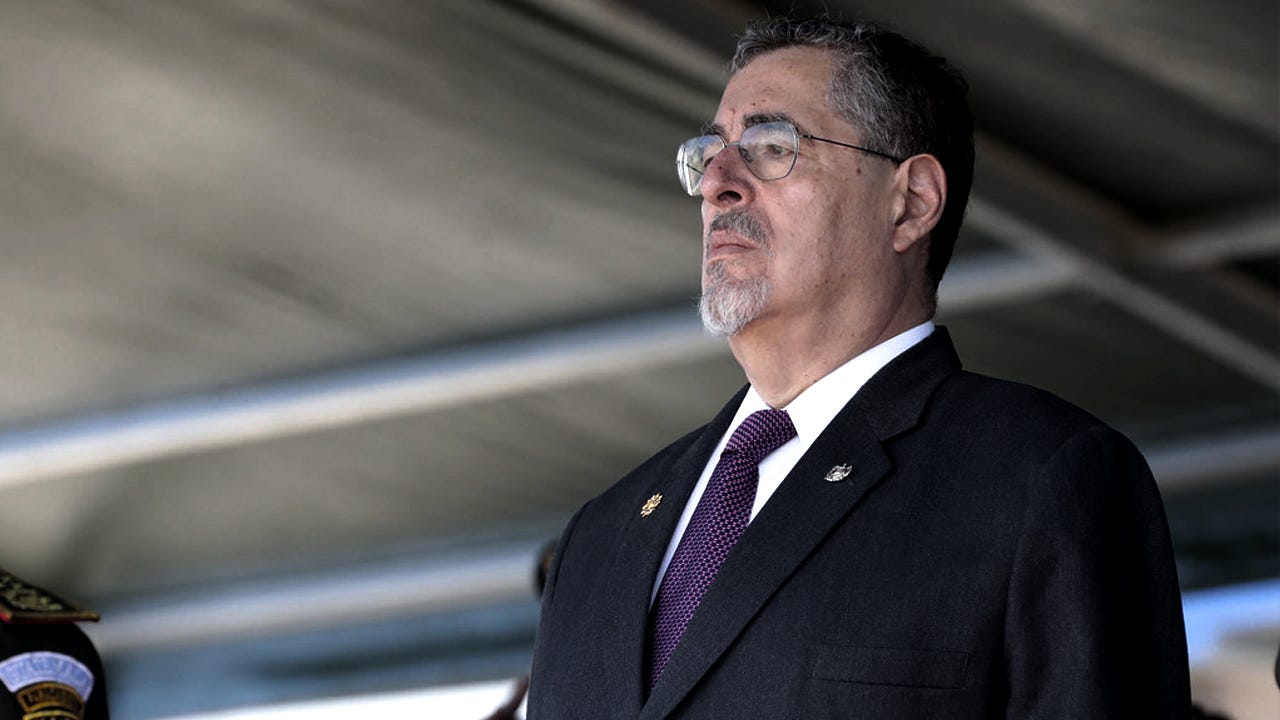
Guatemalan President Bernardo Arévalo has purported to be an advocate for democracy and human rights during his time in office, criticizing corruption and playing lip service to U.S. objectives to stay off the radar of the Trump administration during a time when Latin America has become a top priority.
Arévalo has pledged to help the U.S. by cooperating with the deportation of migrants and also worked with the Trump administration on an Agreement on Reciprocal Trade. Arévalo’s maneuvering has kept him off the Trump administration’s enemies list thus far, in contrast to his bolder counterparts, Colombian President Gustavo Petro or Honduran outgoing President Xiomara Castro. But the indictment of deposed Venezuelan dictator Nicolas Maduro shows exactly how Guatemala has turned a blind eye to drug trafficking under Arévalo’s watch.
OPERATING MADURO’S DRUG SANCTUARY
In the federal indictment against Maduro, Guatemala is identified as a primary transshipment point for massive cocaine shipments en route to the U.S. The indictment provides evidence that Maduro’s regime conspired with narco-terrorist groups and cartels to ship processed cocaine from Venezuela to the U.S. specifically via Guatemala, Honduras, and Mexico.
The indictment also details how the Maduro-aligned Cartel de los Soles (Cartel of the Suns) partnered with groups like the Sinaloa Cartel and the FARC to utilize Central American routes, including those in Guatemala, due to their established expertise in smuggling across borders. U.S. data notes that thousands of metric tons of cocaine have passed through Guatemala to the U.S. while Arévalo has looked the other way, due to either cowardice, incompetence or complicity.
Attorney General Pam Bondi drew attention to the role of Arévalo’s government in facilitating the drug trade during an appearance on Fox Noticas last year.
“There is an air bridge where the Venezuelan regime where they pay to have free airspace access undetected to Honduras then Guatemala and to Mexico where they can traffic these drugs, transport these drugs. They are exchanging money for bribes. They are exchanging weapons for the ports of entry and airspace to get these drugs to all these other countries and into the United States,” AG Bondi said.
DRUG GANGS RUN WILD
Along with permitting illicit drug running through Guatemala, Arévalo has adopted soft-on-crime policies that have led to widespread unrest and put law enforcement in the crosshairs. Just this past weekend, three separate prisons were overrun by inmates who took 46 hostages in an attempt to gain freedom for Barrio 18 gang leader El Lobo. After El Lobo was subdued and the weekend’s prison revolt was put down, police officers were targeted in a murderous retribution campaign throughout the capital of Guatemala City.
At least seven police officers were slain in the aftermath with ten police officers injured, prompting Arévalo to declare a state of siege, essentially a temporary order of martial law. The homicide rate has risen under Arévalo from 16.1 per 100,000 inhabitants in 2024 to 17.65, according to the Center for National Economic Research. This follows a prison break from last year in which members of the Arévalo administration were accused of freeing violent gang members as part of an illicit secretive agreement.
In Oct. 2025, twenty members of the Barrio 18 gang were discovered as having escaped from a prison in Guatemala right as the gang was designated as a terrorist organization by the Trump administration.
The prison break came as a result of a scheme hatched with alleged cooperation by corrupt authorities, including members of Arévalo’s cabinet. Arévalo’s Minister of the Interior Francisco Jiménez resigned in the fallout of the scandal with ex-vice minister Claudia del Rosario Palencia, Jiménez’s second in command, and former subdirector Víctor Arnoldo Alveño Barco being prosecuted for their alleged role in the jail break.
Former Public Prosecutor Juan Francisco Solórzano Foppa accused Jiménez and Rosario Palencia of striking a deal with the Barrio 18 gang, under the ridiculous notion that making a deal with the narcoterrorists would lead to a reduction of violence in the country (which, as seen by the hostage crisis and subsequent murders of police, was an abysmal failure). These allegations would later be corroborated with testimony from apprehended Barrio 18 members during court proceedings.
“My version is that this occurred with full complicity from the top of the Interior Ministry, meaning the minister and the deputy minister, even with senior National Civil Police officials, who allowed these inmates to exit in police uniforms during one of the many inspections in August,” Solórzano said.
However, these allegations were never properly investigated. Arévalo made sure to protect his former Interior Minister from being prosecuted – belying his public image as a nonpartisan reformer. Jiménez was set to turn himself in to authorities but opted against it after meeting with Arévalo’s team. After Jiménez reportedly fled from Guatemala in an attempt to escape justice, Arévalo played dumb as the scandal dwindled from the public consciousness.
In the weeks after the prison break, María Fernanda Bonilla emerged as a whistleblower exposing the systemic bribery operation within the Guatemalan prison system that allows gang members to exchange money for transfers and favors. Salvadoran gangs like Barrio 18 and MS-13 have thrived in Guatemala after fleeing their native country following El Salvadoran President Nayib Bukele’s unprecedented crackdown with Arévalo’s weak, narco-friendly governance giving them a safe haven to rape, abduct, murder and sell drugs.
INSTALLED BY BIDEN-BACKED ELECTION FRAUD
Arévalo has shown an adeptness to play whatever role is needed to secure U.S. support and backing. Like Maduro, Arévalo has manipulated the electoral process to achieve and maintain power. Arévalo was installed through a color revolution coup of sorts plotted by the Biden State Department. Arévalo won election in 2023 amidst widespread claims of voter fraud. The Biden/Harris regime had sent foreign agents, admitted after the fact in a Washington Post article, to enable Arévalo’s rise, also threatening economic sanctions if the public resisted their hand-picked puppet.
“The countries of the European Union jumped all over us, the big bosses of the North [United States] jumped all over us,” said former Guatemalan President Alejandro Giammattei, who “lost” to Biden-backed Arévalo in 2023.
“The [Biden] administration made quite a dramatic turn and saw they had a real opportunity, a golden opportunity… They pulled out as many of the big guns as they could,” said Eric Olson, who works for the Seattle International Foundation as a political analyst specializing in Central America.
To secure Arévalo’s victory, the Biden administration and Soros-allied NGOs engineered a nationwide protest exploiting Guatemala’s beleaguered indigenous population and coercing them to engage in ANTIFA-style tactics blocking roads and obstructing commerce. Around the same time, the Biden Treasury Department placed arbitrary sanctions over alleged public corruption against influential former government official Miguel Martínez, who was closely connected to then-President Giammattei.
A week later, the Biden State Department announced the cancellation of visas for 300 prominent Guatemalans, including two-thirds of the elected members of Congress and business leaders aligned with then-President Giammattei. The intervention from the Biden administration was eventually successful, and Arévalo was crowned the new President on the mandate to initiate a crackdown on corruption which never came.
“Your election has brought a sense of optimism to the people of America and around the world,” former Vice President Kamala Harris told Arévalo after Democrats installed him into office. “And despite the challenges that have been posed to Guatemala’s democratic process, the United States was proud to stand with you, Mr. President, following a free and fair election.”
Following Arévalo’s ascent into power Vice President Harris announced an additional $170 million in foreign aid, including $135 million from the now-defunct USAID bureaucracy, that would be sent to Guatemala to facilitate various “woke” directives in the country. In a since-deleted post by the U.S. Embassy to Guatemala, they announced the spending was in part to “protect human rights” and “promote social inclusion of women, youth, and indigenous people.”
Guatemalans are beginning to see through Arévalo’s facade as his failed leadership allows drug gangs to terrorize the streets. Opinion polls show Arévalo with a dismal favorability rating of 23 percent, and those numbers are not likely to rebound before the country’s next round of national elections set to take place in 2027. Guatemala may be ripe for a national renaissance, throwing off the shackles of narco-socialism by embracing prosperity and law and order. The ouster of Maduro further puts the writing on the wall for Arévalo that his days are numbered, and it will be only a matter of time before Guatemala joins nations like Honduras, Ecuador, Chile, Paraguay, El Salvador, Argentina, and of course Venezuela that have joined President Trump’s vanguard of hemispherical liberation.
Go totally Bukele on him!
The problem is in the US and no matter how hard you crack down on the cartels, the problem will continue. Did the US learn absolutely nothing from Prohibition?