


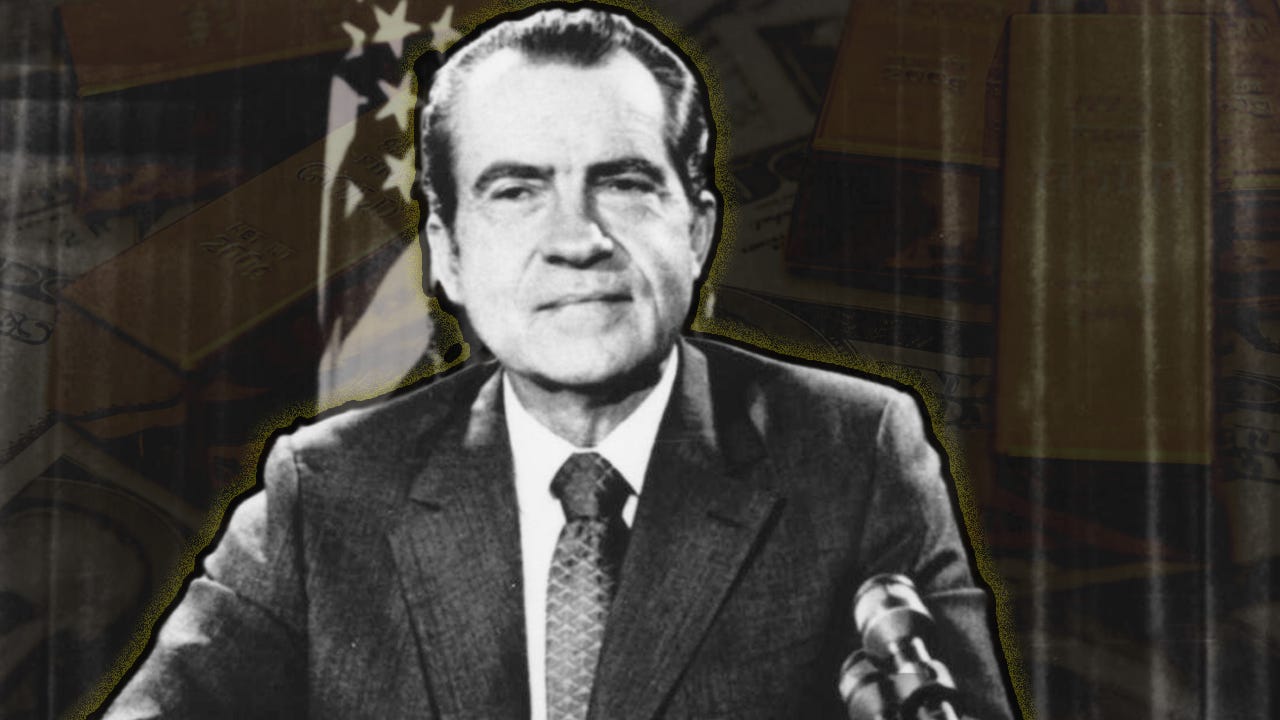
On a warm Sunday evening fifty-five years ago today, Americans gathered around their televisions to hear President Richard Nixon unveil an ambitious package of economic changes. One historic announcement stood out among the steps to curb the rising cost of living: the United States would no longer redeem dollars held by foreign governments for gold.
America’s spending on the Vietnam War, Great Society programs, and overseas investment had poured dollars abroad far faster than the Treasury’s gold stock could support.
By 1971 U.S. gold reserves equaled only about one-quarter of the dollars held by foreign governments and central banks, down sharply from the comfortable surplus of the 1950s.
Domestic inflation, already rising from the mid-1960s, was being exported through the fixed-rate system and intensifying pressure on the dollar.
The final trigger came in early August when Britain requested roughly $3 billion in gold “cover” for its dollar holdings, following earlier French conversions.
On the weekend of August 13–15, Nixon and a small group of advisers met in secret at Camp David and chose to act.
Closing the gold window was necessary. It ended the Bretton Woods system that had governed international money since the end of World War II and launched the modern era of pure fiat currency.
A brief attempt to restore modified fixed rates followed in the December 1971 Smithsonian Agreement, which raised the official gold price to $38 an ounce, but that arrangement collapsed within little more than a year, leading to generalized floating by early 1973.
The move was the only responsible response to an approaching crisis:
It prevented an immediate crisis and gold drain. U.S. gold reserves had fallen sharply and could no longer cover outstanding foreign claims on the dollar. Continuing convertibility risked a disorderly run on gold, potential default on obligations, and a broader international financial panic. Convertibility had already been restricted since the 1968 collapse of the London Gold Pool, which left only official transactions at the $35 price. Ending convertibility removed that immediate threat.
Corrected an overvalued dollar and improved competitiveness. The fixed $35-per-ounce rate made U.S. goods expensive abroad and imports artificially cheap. Ending convertibility, combined with a temporary 10% import surcharge, was intended to force other countries to revalue their currencies upward, effectively devalue the dollar in real terms, boost U.S. exports, and improve the trade balance and employment. The surcharge was dropped after the Smithsonian negotiations.
Gave greater policy flexibility. Under a pure gold-linked system, domestic monetary and fiscal policy was constrained by the need to defend the gold parity. Severing the link allowed more active management of inflation, unemployment, and growth without automatic gold outflows or forced deflation. Supporters later noted that fiat money and floating (or managed) exchange rates give central banks tools to respond to recessions and shocks that a rigid commodity standard would limit.
Political and short-term economic goals. The package included a 90-day wage-price freeze and tax measures aimed at cooling inflation while supporting jobs ahead of the 1972 election. Closing the gold window was framed as protecting the dollar from “speculators” and shifting focus to domestic priorities after Vietnam. Many contemporaries viewed the overall New Economic Policy as popular at the time. Markets initially responded positively, with the stock market rising in the days after the announcement.
Exposed that Bretton Woods was already unsustainable. The system had been under strain for years (the London Gold Pool collapsed in 1968). It also suffered from the inherent “Triffin dilemma”: the United States had to run deficits to supply the world with dollar liquidity, yet those same deficits steadily undermined confidence in the dollar’s convertibility into gold. Unilateral action was seen by some as preferable to a drawn-out, potentially messier collapse or endless negotiations that might not succeed.
Yet the same step that averted an immediate crisis also carried lasting costs. The other side of the coin remains clear. In both books I have written on Richard Nixon, Nixon’s Secrets , the Rise, Fall and Untold Truth about the President, Watergate and the Pardon and Tricky Dick - the Rise and Fall and Rise of Richard M. Nixon I have been critical of this decision.
America lost its monetary anchor and higher inflation risk. Gold provided an external discipline that limited the ability of governments and central banks to expand the money supply excessively. Critics argued that ending convertibility removed this constraint, contributing to the high inflation and “stagflation” of the 1970s (though oil shocks and other factors also played major roles). Over the long term, the dollar has lost substantial purchasing power since 1971 under the fiat regime.
Created currency volatility and uncertainty. The shift from fixed rates to floating, or managed floating exchange rates introduced greater short-term volatility in currency markets. This required new hedging instruments and complicated international trade and investment planning. Some preferred negotiated reform of Bretton Woods over a unilateral break.
Damaged U.S. credibility and relations with allies. The action was unilateral and sudden, negotiated over a secret Camp David weekend. Allies holding large dollar reserves saw it as the United States defaulting on a core commitment. The episode strained relations and temporarily closed foreign exchange markets.
Wage-price controls and other accompanying measures were flawed. The freeze, and later controls, distorted markets, suppressed rather than cured inflation, and created shortages or pent-up price pressures that erupted later. Fed Chairman Arthur Burns and others opposed closing the gold window, warning of the risks of pure paper money and potential loss of confidence.
Undermined longer-term fiscal discipline. Without the gold constraint, governments faced fewer automatic checks on deficit spending and debt monetization. Critics, especially from free-market or gold-standard perspectives, argue this facilitated the large growth in federal debt and spending that followed.
On that Sunday evening the United States stepped out of the Bretton Woods system and into a different monetary order. The move was driven by necessity more than ideology, yet its consequences have proved lasting.
Nixon’s action averted a disorderly collapse of the postwar monetary system; it also removed the discipline that gold had imposed. Both statements are true, and both continue to shape how the episode is judged. The gold window was closed to protect the remaining reserves and to restore competitive balance. Once closed, it stayed closed.
Many still point to the policy freedom that followed; while others still point to the inflation, volatility, and fiscal expansion that became easier once the link was severed.
Fifty-five years on, the world continues to operate inside the framework that night created, one of floating rates, pure fiat currency, and the permanent question of how far governments should be free to create money without an external limit. The argument over what that decision ultimately cost has never really ended.
The gold standard argument never really ended because Nixon solved one crisis by creating another kind of permission structure. Gold restrained politicians because it told them no. Fiat money tells them maybe. Maybe print. Maybe borrow. Maybe inflate. Maybe paper over war, welfare, debt, bailouts, and managed decline with another round of monetary manipulation. Nixon may have had no clean choice in 1971. Vietnam, Great Society spending, foreign claims, and contradictions at Bretton Woods had boxed him in. But once the anchor was cut, Washington learned the most dangerous lesson in politics: discipline can be postponed. The bill still comes.
It gave the government a blank check 39 trillion worth of checks and still writing. It brings forward another question. What’s the reason for wars and who benefits from them?