


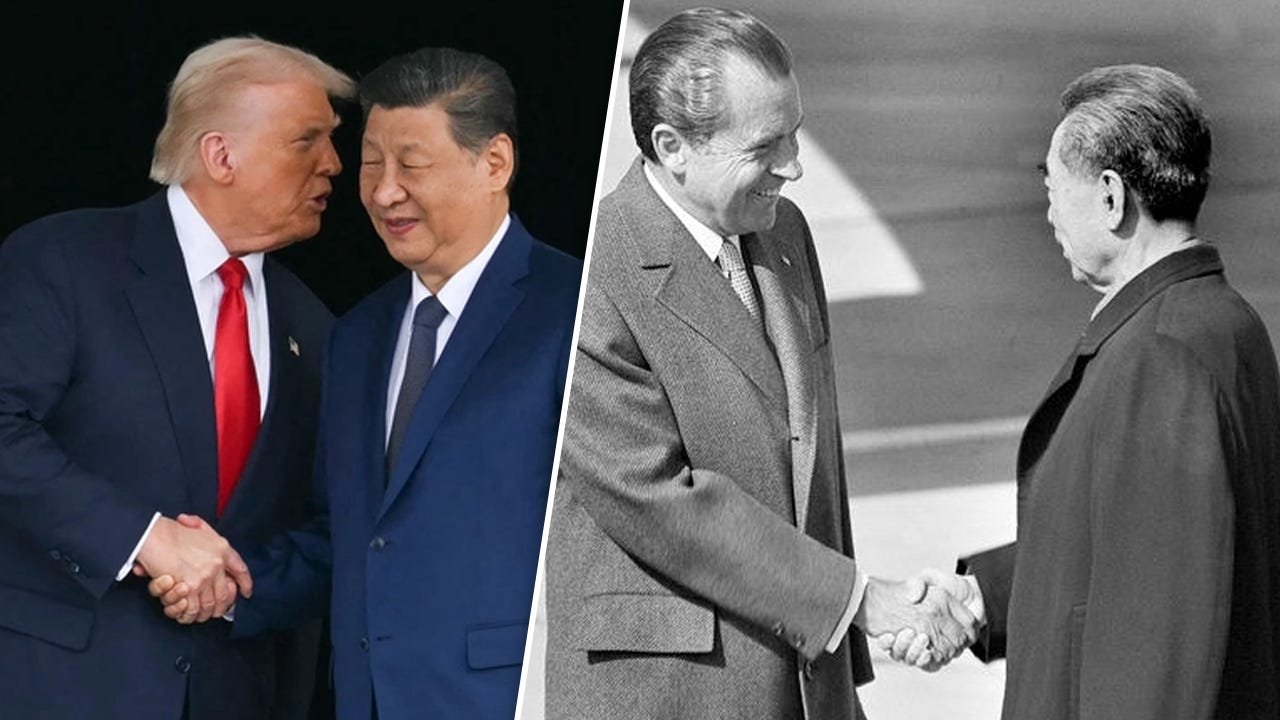
In foreign policy, timing, leverage, and national interest must guide the strategy of engagement with rising powers. President Richard Nixon grasped this principle as well as any Chief Executive during his groundbreaking 1972 opening to China. President Bill Clinton, however, failed his test when he championed China’s entry into the World Trade Organization (WTO) and Permanent Normal Trade Relations (PNTR) in 2000. President Donald Trump’s recent state visit to Beijing revives the Nixonian tradition of pragmatic, interest-driven diplomacy with a foreign adversary—engaging from strength while delivering concrete American wins—while actively correcting the structural imbalances and strategic vulnerabilities created by the failures of past policies.
When Nixon landed in Beijing in February 1972, China was a desperately poor, agrarian society still recovering from the Cultural Revolution. Rural areas largely lacked indoor plumbing, and electricity access was minimal; rural electricity consumption was only about 1-10% of national totals in the 1960s-1970s. Its military was massive in manpower but technologically backward, with limited projection capability. GDP per capita hovered near subsistence levels. Nixon, the consummate anti-communist, pursued classic realpolitik: exploiting the Sino-Soviet split to isolate Moscow, ease pressure in Vietnam, and create a triangular balance of power. The Shanghai Communiqué was deliberately cautious—acknowledging differences, opposing hegemony in Asia, and committing to gradual normalization and people-to-people contacts without massive technology transfers or one-sided economic concessions. Trade in 1972 stood at a mere $95.9 million. Nixon built a bridge across 22 years of hostility, famously declaring it “the week that changed the world,” but he did so without arming or enriching a future rival at America’s expense.
Clinton’s policy marked a sharp and consequential departure from Nixon’s success. Convinced that economic liberalization would foster political openness, the administration granted PNTR in 2000 and supported China’s WTO accession in 2001. U.S. officials projected modest trade growth and mutual benefits. Reality proved otherwise. Pre-WTO (2001), the U.S. goods trade deficit with China was about $83 billion. By 2015, it had ballooned to $367 billion—an annual average increase of over $20 billion. Imports from China surged from $102 billion to $483 billion, while U.S. exports grew far more slowly from a smaller base. Economists estimate this “China Shock” displaced 2.4 to 3.4 million U.S. jobs, with roughly 2.6 million in manufacturing, devastating communities in electronics, apparel, furniture, and other sectors. China’s economy exploded—eleven times larger by some measures post-accession—fueled by foreign investment, technology transfers, and export-led growth. Its military modernized rapidly, shifting from coastal defense to blue-water ambitions. What Nixon engaged as a weak agrarian power, Clinton’s policies helped transform into an economic and military superpower.
President Trump’s May 2026 visit to China reflects a Nixonian calculus adapted to 21st-century realities: direct personal engagement, tangible reciprocal deals, and firm guardrails on strategic competition. Like Nixon’s trip, it featured high-level meetings, cultural exchanges, and warm rapport with leadership. Xi Jinping may be a wicked man like Mao Zedong clearly was, but those characterizations are often immaterial pertaining to geopolitical realities. Unlike Clinton’s broad market-opening that disproportionately benefited China, President Trump secured specific wins for American exporters. China committed to an initial 200 Boeing aircraft purchase (with potential expansion to 750), plus hundreds of GE jet engines—reopening a critical market for U.S. aviation and supporting thousands of American manufacturing jobs. Agricultural agreements promise “double-digit billions” in annual purchases of U.S. soybeans, beef, and other farm products. Expanded imports of American oil and LNG further bolster U.S. energy producers. New bilateral mechanisms, including a U.S.-China Board of Trade under a reciprocal tariff framework, aim to stabilize ties on more balanced terms.
These outcomes contrast sharply with the post-Clinton era’s imbalances. President Trump negotiates from strength—leveraging tariffs, export controls, and alliances—while delivering immediate benefits to U.S. farmers, manufacturers, and energy workers. The approach wisely manages competition without repeating the naive bet that economic integration alone would moderate Beijing’s behavior. Nixon engaged a fragmented, impoverished China to counter the Soviets; President Trump is engaging a powerful China to prevent dominance in key sectors, secure supply-chain resilience, and protect critical infrastructure and technology.
Trump has scored with a commitment from China not to provide weapons to Iran and China will not support Iran’s development of a nuclear weapon at the same time getting commitments for the purchase of American agricultural products like soybeans, beef and pork. The Chinese have also agreed to purchase 200 Boeing aircraft. Trump deals from strength haven cut China’s access to cheap oil from Venezuela and Iran.
History underscores the difference in risk. Engaging a weak China in 1972 carried manageable downsides. Empowering it through unconditional access after 2000 gave a burgeoning rival everything it needed to obtain global hegemony. President Trump’s bridge-building seeks to restore reciprocity and leverage, honoring Nixon’s realism while repairing decades of policy missteps. The test ahead is whether sustained pressure and targeted engagement can produce a stable, interest-based relationship that prioritizes American workers, security, and prosperity—outcomes put on the backburner due to the neoliberal Clinton consensus. In an era of competing world powers, Nixonian prudence without wearing ideological rose-colored glasses offers the wiser path forward.
The difference is simple. Nixon understood China as a chess piece. Clinton treated China like a customer and created a monster. Trump understands China as a rival that must be managed, pressured, and forced into reciprocity. The old neoliberal fantasy said trade would make Beijing freer. Instead, it made China richer, stronger, and more dangerous while American towns got hollowed out. Trump’s approach is not naïve engagement. It is brass-knuckle diplomacy with purchase orders attached. He cut off China’s cheap-oil lanes from Venezuela and Iran, then walked into Beijing with leverage. That is Nixonian realism rebuilt for America First.
Quite the stark difference between Tricky Dick and Slick Willie.