


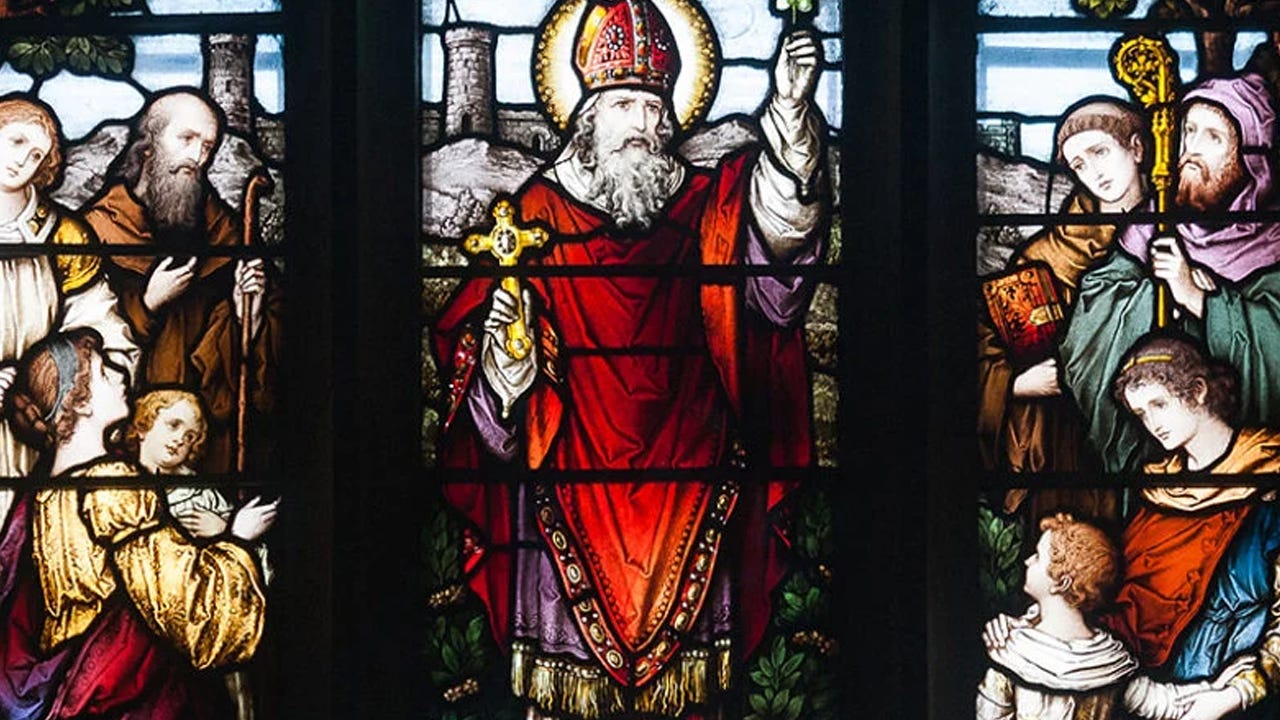
The Feast of Saint Patrick is far more than a day of merriment, emerald attire, and jovial excess. It is, at its core, a solemn and sacred observance within the Catholic Church, a day that commemorates a man whose life reads less like legend and more like a providential drama written by the hand of God Himself.
Saint Patrick was not Irish. This alone is enough to startle those who casually equate him with the very essence of Ireland. He was born in Roman Britain in the late fourth century, around 385 AD, into a Christian family whose lineage was steeped in ecclesiastical service. His father was a deacon, his grandfather a priest. Yet, like many young men of privilege, Patrick’s early life was marked more by indifference than devotion.
That indifference would be shattered with violent abruptness. At the age of sixteen, he was abducted by Irish raiders and carried across the sea into bondage. Imagine the terror of a young man torn from civilization and cast into a foreign land, stripped of comfort, reduced to servitude. For six years he toiled as a shepherd, exposed to the elements and the brutal solitude of captivity. Yet it was in this crucible of suffering that his soul was refined. Hardship became his seminary. Isolation became his sanctuary. Prayer, once neglected, became his lifeline.
After years of enslavement, he escaped, guided as he believed by divine revelation, and returned home. At this juncture, any reasonable man would have sought permanence in safety. But Patrick was not governed by reason alone. He was animated by vocation. In a decision as astonishing as it was courageous, he resolved to return to Ireland, the land of his captivity, not as a slave but as a missionary.
This is where Saint Patrick’s life ascends into the realm of the extraordinary. In the early fifth century, he reentered Ireland with a singular purpose. He would convert a pagan society steeped in druidic ritual to Christianity. This was not merely a religious undertaking. It was a civilizational transformation. To walk into a land of tribal kings and entrenched pagan customs armed only with faith is akin to stepping into a tempest with nothing but a candle, yet Patrick’s candle did not extinguish. It ignited.
He preached, baptized, established churches, and converted leaders. His method was neither brutish nor naïve. It was strategic, patient, and infused with a profound understanding of the people he sought to reach. Over time, his efforts bore fruit, and Ireland, once a stronghold of paganism, became a bastion of Christian faith.
The Catholic Church venerates Saint Patrick as the patron saint of Ireland and March 17, which we believe to be the date of his death around 461 AD, is observed as his feast day. This is not merely a historical anniversary. It is a liturgical celebration, a day of Mass, prayer, and reflection for Catholics worldwide. In churches, the vestments turn green, symbolizing hope and renewal. The faithful gather not just to remember Patrick, but to emulate his perseverance and evangelistic zeal.
It is important to note that Saint Patrick’s veneration is not confined to Catholicism alone. He is also recognized as a saint by the Anglican Communion, including the Church of England, as well as by the Lutheran Church and certain other Protestant traditions that honor early Christian figures. While the theological frameworks may differ, the admiration for Patrick’s courage, sanctity, and missionary success transcends denominational boundaries.
Unlike saints canonized in later centuries through formal Vatican procedures, Patrick’s sainthood emerged organically. In the early Church, sanctity was affirmed by acclaim, by the testimony of the faithful, by the enduring impact of a life lived in service to God. Patrick did not need a tribunal to declare what history had already inscribed.
Of course no account of Saint Patrick would be complete without acknowledging the legends that have grown around him. The story of his banishing snakes from Ireland is almost certainly allegorical, a poetic representation of his role in eradicating paganism. The shamrock, said to have been used by Patrick to explain the Holy Trinity, remains one of the most enduring symbols associated with his name. Whether literal or metaphorical, these stories capture a deeper truth about his mission.
In the centuries since his death, the Feast of Saint Patrick has evolved into a global celebration. Parades, music, and festivities abound, particularly in the United States where Irish heritage is celebrated with exuberance. Yet even amid the revelry, the essence of the day remains rooted in faith. The secular celebration is but the echo. The religious observance is the voice.
Saint Patrick’s life is a testament to the transformative power of conviction. He was a man who turned suffering into purpose, captivity into calling, and exile into evangelization. If his life were a tapestry, it would be woven with threads of trial and triumph, forming a pattern that reveals divine providence at work.
There is something almost paradoxical in his story. The land that enslaved him became the land he saved. The people who once held him in chains became the people he led to Christ. It is a narrative that defies cynicism and demands reflection. So as the world dons green and raises a glass of Guinness, let us not forget the man behind the myth. Let it remember the missionary, the shepherd, the apostle who walked into darkness and, through faith, illuminated an entire nation and thus, the world.
Sláinte
This was truly a divine piece on the life of St. Patrick. I have never read a better enunciation of the true purpose and meaning of his life. Well done Roger. A beautiful read.
Roger, your eloquent tribute to St Patrick, “Enlightener of Ireland” is but one of your many lucid blogs and has persuaded me to become a paid subscriber. As an Orthodox Christian I am compelled to note that having emerged in the Nicene period before the Great Schism when both the East and West were of one Apostolic faith, St. Patrick is revered by Orthodox Christians as well. In the first millennium virtually all the saints were acknowledged organically rather than by the formal process later instituted by Rome.