


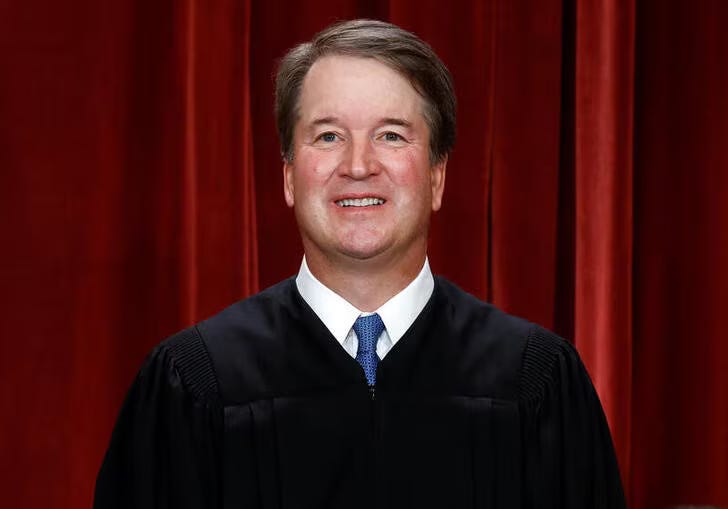
In June 2022, a chilling plot to assassinate Supreme Court Justice Brett Kavanaugh was thwarted, revealing a complex web of motives, mental health struggles, and political extremism. The suspect, Nicholas John Roske, a 26-year-old from Simi Valley, California, later identified as transgender and using the name Sophie Roske, arrived at Kavanaugh’s Maryland home armed with a Glock-17 pistol, ammunition, zip ties, a tactical knife, pepper spray, a hammer, a screwdriver, a nail punch, a crowbar, duct tape, and stealth-padded boots. This incident, which could have altered the course of American jurisprudence, has raised questions about why it received limited attention from certain media outlets, particularly those aligned with left-leaning perspectives.
The Plot unfolded on June 8, 2022, when Roske flew from California to Dulles International Airport and took a taxi to Kavanaugh’s residence in Chevy Chase, Maryland, arriving around 1:05 a.m. Dressed in black and carrying a suitcase and backpack filled with weapons and burglary tools, Roske intended to break into the justice’s home, kill him, and then take his own life. His motivations stemmed from anger over the leaked draft of the Supreme Court’s Dobbs v. Jackson Women’s Health Organization decision, which signaled the overturning of Roe v. Wade, the 1973 ruling that established a constitutional right to abortion. Roske also expressed frustration over a recent school shooting in Uvalde, Texas, and his belief that Kavanaugh would support loosening gun restrictions.
Court documents later revealed Roske’s plan was even more ambitious and alarming. He aimed to kill three conservative Supreme Court justices, hoping their deaths would allow President Biden to appoint liberal replacements, thereby shifting the court’s ideological balance for decades. In online messages, Roske wrote, “I’m gonna stop Roe v. Wade from being overturned” and “I could get at least one, which would change the votes for decades to come.” His internet searches included phrases like “most effective way to silently kill someone,” “how to break a lock,” and “assassin skills,” showing meticulous planning.
Fortunately, the plot was foiled before it could be executed. Two deputy U.S. Marshals stationed outside Kavanaugh’s home noticed Roske stepping out of the taxi. Sensing the presence of security, he walked away from the residence and texted his sister, revealing his intentions. She convinced him to call 911. At 1:38 a.m., Roske contacted Montgomery County’s emergency communications center, admitting he was suicidal, armed, and had traveled to Maryland to kill a Supreme Court justice. He emphasized his desire to be compliant, saying, “I’m standing now, but I can sit, whatever. I want to be fully compliant.” Police arrested him without incident while he was still on the phone.
Roske, who pleaded guilty to attempting to assassinate a Supreme Court justice in April 2025, has been described as deeply mentally ill and suicidal. Court filings and online activity from before the incident show that Roske identified as a transgender woman, using the name Sophie and female pronouns. In online forums, Roske referred to himself as a “trans gamer girl” and “sissy slave,” and advocated extreme views, including mandatory abortions to end human suffering by preventing new births. These posts, uncovered by various news outlets, painted a picture of a troubled individual with radical ideologies.
In September 2025, the Department of Justice recommended a 30-year prison sentence for Roske, with prosecutors calling the attempt a “heinous attack on the court itself.” Roske’s defense attorneys noted his transgender identity in court filings, requesting that he be referred to as Sophie Roske out of respect, though his legal name remained unchanged. A judicial source suggested Roske had identified as a woman even before the assassination attempt, raising questions about how his mental health and ideological leanings intersected with his actions.
The Kavanaugh assassination attempt, while covered by some major outlets, did not receive the sustained attention one might expect for a plot targeting a Supreme Court justice. Critics argue that left-leaning media downplayed the story due to Roske’s motivations and identity. The timing of the incident, just weeks after the Dobbs leak sparked protests outside justices’ homes, placed it in a politically charged context. Some speculate that the media’s reluctance to dwell on the story stemmed from Roske’s alignment with progressive causes, such as abortion rights, and his transgender identity, which could complicate narratives favored by left-leaning outlets.
On June 13, 2022, FOX News published an article and noted the story didn’t capture Washington’s attention as much as expected, explicitly criticizing major left-leaning outlets (e.g., The New York Times, ABC, NBC, CBS) for providing minimal coverage of the Nicholas Roske assassination attempt on Justice Brett Kavanaugh, noting that the story “quickly [became] old news” to them despite its gravity amid heated political rhetoric over the leaked Roe v. Wade draft opinion. The limited coverage from major news outlets, which relegated the story to less prominent pages, and the absence of discussion on some prime-time news reveals evidence of bias.
The revelation of Roske’s transgender identity in 2025 further fueled accusations of a cover-up. Many Conservative outlets claimed the left had deliberately obscured this aspect of the case to avoid scrutiny of the transgender community or progressive activism. They pointed to other incidents involving transgender individuals as evidence of a troubling pattern of violence that they believe is underreported.
The Kavanaugh plot was not an isolated incident. It occurred amid a wave of threats against judges and public officials, particularly following controversial Supreme Court decisions. Protests outside justices’ homes, bomb threats, and swatting incidents targeting judges have heightened concerns about judicial security. In response, House Republicans passed a measure in September 2025 to boost the Supreme Court’s security fund by $28 million, though it did not address protections for lower court judges.
The attempted assassination of Justice Brett Kavanaugh was a stark reminder of the risks faced by public figures in a polarized era. Roske’s plot, driven by a mix of ideological fervor and personal distress, was thwarted by a combination of vigilant security and his own decision to seek help. Roske’s case underscores the dangers of political polarization and mental instability converging in acts of violence. His stated goal of reshaping the Supreme Court through assassination reflects a radical mindset that transcends typical political discourse. The limited media focus on the case, compared to other high-profile violent incidents, raises legitimate questions about whether ideological biases influence what stories gain traction. Yet the story’s relatively muted coverage, especially in light of Roske’s transgender identity and progressive motivations, has sparked debate about media priorities. As Roske awaits sentencing on October 3, 2025, the incident serves as a call to address both the mental health crisis and the growing threat of political violence, while ensuring that no story, no matter how inconvenient, is swept under the rug.
This was an obvious case where political ideology steered the presstitute coverage of the incident.
Almost no one talks about the intended killing of a Supreme Court justice because that would just be 1 of 9 votes. However, tis miscreant was planning to kill 3!
I would also link this attempted murder story to the call of Sen Chuck Schumer calling for justices Gorsuch and Kavanaugh to "reap the whirlwind" when he ranted like a lunatic in front of the Supreme Court building several years ago.
It all boils down to the fact that Diversity leads to a culture of less and less consensus, until the situation ultimately becomes unmanageable.