


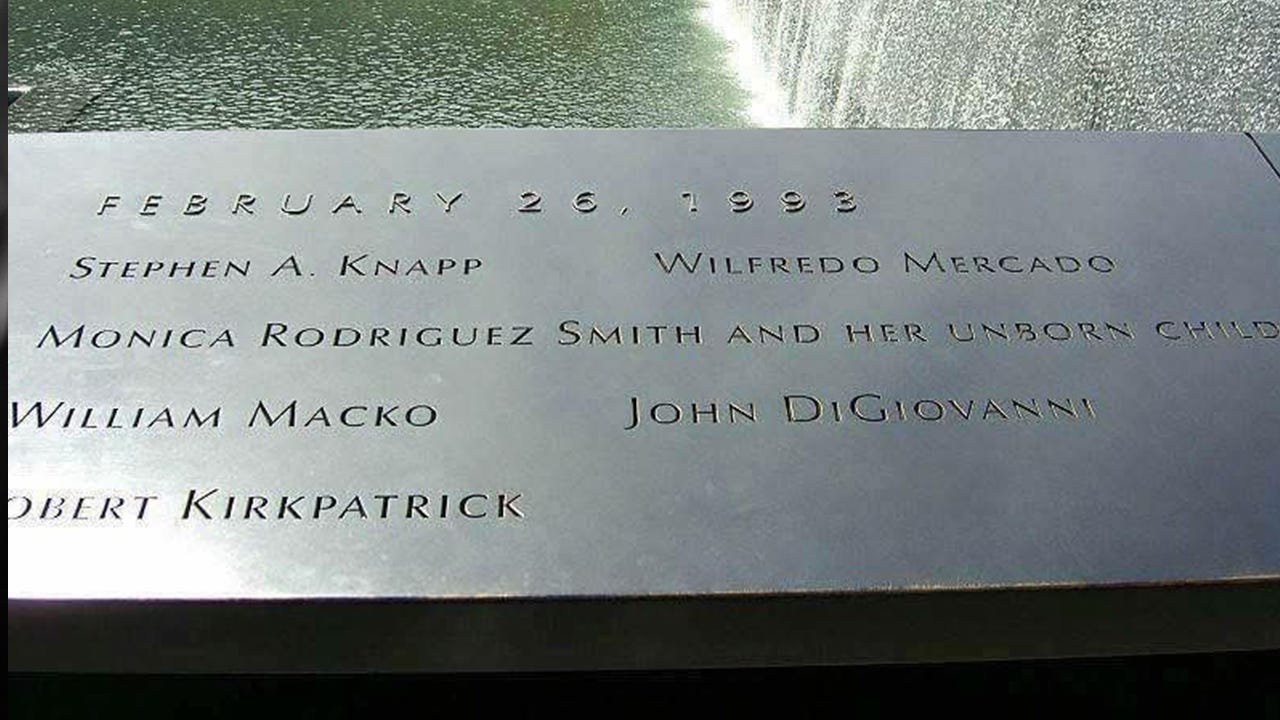
On February 26, 1993, at 12:18 p.m., a rented yellow Ryder van rolled into the B2 Level of the underground public parking garage beneath the North Tower of the World Trade Center and changed American history. Inside the vehicle was a massive urea nitrate fertilizer based bomb weighing roughly 1,200 to 1,500 pounds, enhanced with hydrogen gas cylinders and reportedly laced with sodium cyanide. When it detonated, the explosion tore open a roughly one hundred foot wide crater, several stories deep, ripped through concrete and steel, and filled the lower levels of the complex with blinding smoke and toxic fumes.
Seven people were killed outright. More than one thousand others were injured, most from smoke inhalation. Roughly fifty thousand people were forced to evacuate the complex in scenes of panic and confusion. Damage exceeded five hundred million dollars. For those who lived through it the day never truly ended.
This was not a random act. It was not the work of a lone madman. It was a carefully planned act of jihad carried out by a small but deadly Islamist cell that had already declared war on the United States.
The mastermind was Ramzi Yousef, a trained bomb maker and the nephew of Khalid Sheikh Mohammad who carried out the 9/11 attacks. Yousef entered the United States in September 1992 on a fraudulent Iraqi passport. Yousef built the device, helped mix the explosives, lit the fuse, and fled the scene. Eyad Ismoil drove the van into the garage. Mohammad Salameh rented the van in his own name and then had the audacity to report it stolen. Nidal Ayyad helped procure chemicals and wrote a claim of responsibility. Mahmoud Abouhalima provided logistical support and later fled the country. Ahmed Ajaj entered the United States alongside Yousef carrying bomb making manuals and operational notes. Abdul Rahman Yasin assisted in mixing the bomb, was questioned and released by the FBI, and then fled to Iraq, where he remains at large with a reward still offered for his capture.
Four of these terrorists were convicted in 1994 and sentenced to 240 years each. Yousef and Ismoil were convicted in 1997 and received the same sentences. They were also linked to the circle of the so-called Blind Sheikh, Omar Abdel Rahman, who would later be convicted in a related terror conspiracy. This was not a sprawling international army. It was a low budget, disciplined cell operating largely out of New Jersey and New York, funded at a cost of about ten thousand dollars, even demonstrating such casual confidence that they used rental coupons to save money.
Their goal was not merely to kill a handful of people. Their goal was to bring down the towers. They drove the van into the parking garage beneath Tower One and parked it on the B two level, where the United States Secret Service parked their fleet. The terrorists parked as close as possible to a load bearing column. They lit a roughly twenty foot fuse and escaped in a getaway car. Yousef later claimed he hoped to kill approximately two hundred and fifty thousand people by toppling the North Tower into the South Tower, causing a catastrophic chain collapse. The plan failed, not because it lacked ambition, but because the van was not positioned in the precise optimal spot to undermine the foundations.
Still…they swore to topple those towers. Nine years later, they pulled it off on September 11, 2001.
The February 1993 bombing was our 9/11 warning. It was the clearest possible signal that jihadist networks had both the intent and the technical capability to strike iconic American targets. It told us that New York City was in the crosshairs. It told us that the World Trade Center itself was a prized objective. It told us that the war had already begun.
Some of the conspirators attended or circulated around the Al Farooq Mosque on Atlantic Avenue in Brooklyn, where Yousef was introduced to key figures through associates of the Blind Sheikh. The mosque itself has long served the local Muslim community, but it gained notoriety in the early 1990s because of these connections and broader investigations into radical preaching. The plot was not born in a vacuum. It grew out of a militant ecosystem that was already present inside the United States.
Yousef did not escape justice. On February 7, 1995, he was captured in Islamabad, Pakistan, at the Su Casa Guest House, where he was preparing another bomb.
Lenny DePaul of the United States Marshals Service led the hunt for them. He played one of the most integral roles in the hunt for one of the world’s most dangerous men. Pakistani intelligence along with U.S. Diplomatic Security Service (DSS) agents carried out the raid after receiving a tip from an associate who later received a two million dollar reward. Yousef was returned to the United States to stand trial in New York, where a jury heard the evidence and delivered a guilty verdict.
For years, political leaders and media figures treated the 1993 bombing as an isolated episode, a law enforcement matter, a crime rather than an act of war. That was a catastrophic misreading of reality. The enemy told us exactly who they were and what they intended to do. We chose not to listen.
Tributes routinely mention the “six” victims who died that day. But it wasn’t six, it was seven. Monica Rodriguez Smith was pregnant. Her unborn child is inscribed on the World Trade Center Memorial panels. Seven lives were taken on February 26, 1993. Seven innocent souls. Seven permanent reminders that the first attack on the World Trade Center was not the prologue to a story. It was the opening chapter.
I was there. It was a snowy day. I always knew they’d come back and then they did on 9/11/2001. Thanks for posting this. And for mentioning Monica Smith’s unborn child.
And the nation is still sleepwalking into something possibly worse to come.