


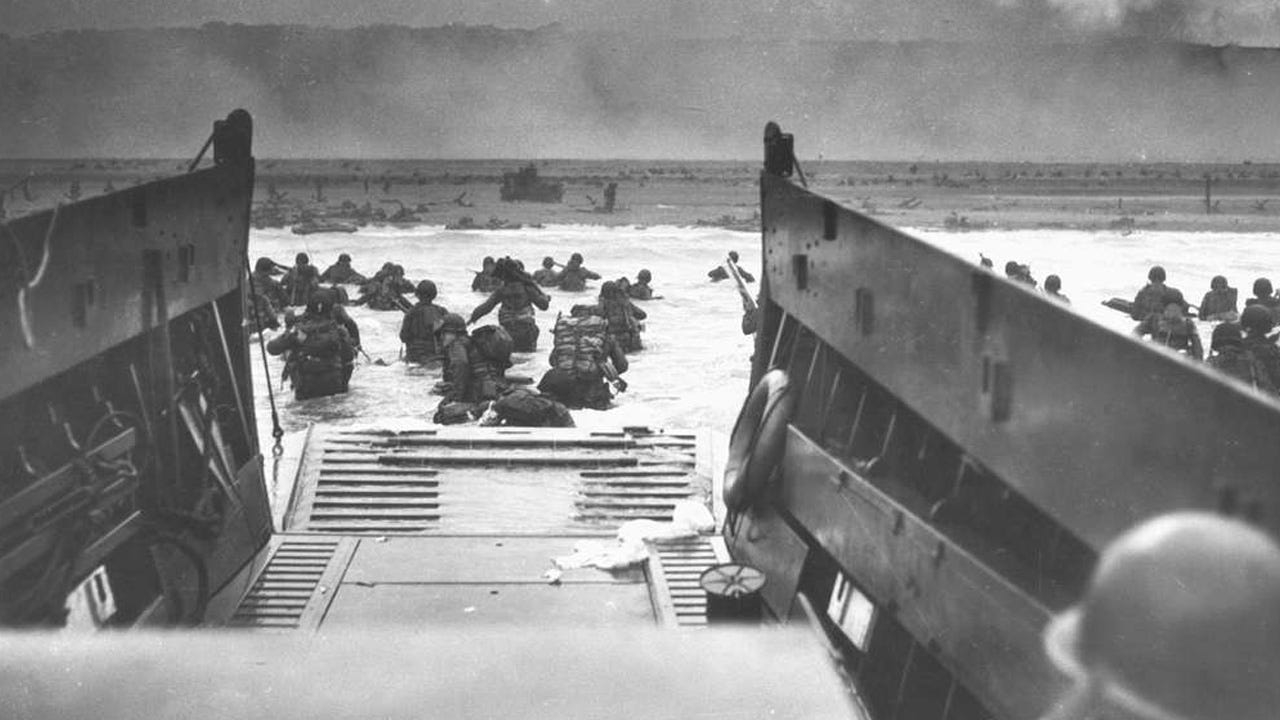
Today, June 6, 2026 we mark the 82nd anniversary of D Day, the greatest amphibious invasion in human history and one of the most consequential days in the history of civilization. It was the day when thousands of young Americans, joined by British, Canadian, and Allied forces from many nations, stormed the beaches of Normandy and began the liberation of Europe from the grip of Adolf Hitler and National Socialism. Their courage altered the course of history. Their sacrifice preserved freedom for millions. Their victory helped save the world.
Today, only a small number of the men who participated in that historic operation remain with us. They belong to what journalist Tom Brokaw famously called the Greatest Generation. They were ordinary citizens who answered an extraordinary call. Farmers, factory workers, students, mechanics, clerks, and laborers became soldiers, sailors, airmen, and Marines. They crossed an ocean knowing that many would never return. They fought not for fame or recognition but because they believed that freedom was worth defending.
The scale of Operation Overlord remains almost impossible to comprehend. Nearly 160,000 Allied troops landed in Normandy on June 6, 1944. More than 7,000 ships and landing craft supported the invasion. More than 11,000 aircraft filled the skies. American airborne troops from the 82nd and 101st Airborne Divisions landed behind enemy lines during the darkness before dawn. At Utah Beach and Omaha Beach, American forces assaulted heavily fortified German positions. British and Canadian forces landed at Gold, Juno, and Sword Beaches. By the end of the day, despite terrible casualties and fierce resistance, the Allies had established a foothold in France.
The bloodiest fighting occurred at Omaha Beach, where American soldiers were met with devastating machine gun and artillery fire. Young men who had never heard a shot fired in anger were suddenly thrust into one of the most violent battlefields in history. Many never made it beyond the surf. Many more pressed forward despite seeing their friends fall beside them. Their determination and courage under fire remain among the most inspiring examples of military heroism ever recorded.
General Dwight D. Eisenhower, the Supreme Allied Commander, understood the gravity of what lay ahead. In his famous Order of the Day issued to Allied troops before the invasion, he wrote: “You are about to embark upon the Great Crusade, toward which we have striven these many months. The eyes of the world are upon you.” He continued, “The hopes and prayers of liberty loving people everywhere march with you.” Those words captured the enormous stakes of the operation. The invasion was not simply a military campaign. It was a battle for the future of freedom itself.
Forty years later on June 6, 1984, President Ronald Reagan stood atop the cliffs of Pointe du Hoc in Normandy and delivered one of the most moving speeches ever given by an American president. Speaking before the surviving Rangers who had scaled those cliffs under enemy fire, Reagan reminded the world of what had happened there. “These are the boys of Pointe du Hoc. These are the men who took the cliffs. These are the champions who helped free a continent. These are the heroes who helped end a war” he said solemnly to the crowd before him listening through their muffled tears. Reagan understood that the story of D Day was not merely about military strategy or battlefield tactics. It was about character, sacrifice, and duty. Looking at the aging veterans before him, he declared, “Forty summers have passed since the battle that you fought here. You were young the day you took these cliffs. Some of you were hardly more than boys, with the deepest joys of life before you. Yet you risked everything here.” The speech remains one of the finest tributes ever paid to the men who fought in Normandy. My readers would be remiss if you were not to take the time to listen to it in its entirety.
Visitors to Normandy today can see the price that was paid for victory. The American Cemetery at Colleville sur Mer overlooks Omaha Beach. More than 9,300 American servicemen rest there beneath rows of white marble Crosses and Stars of David. The grounds are immaculate. The silence is profound. Every grave represents a life cut short in the service of freedom. Across Europe, American cemeteries stand as enduring reminders of sacrifice. From France to Belgium, from Luxembourg to the Netherlands, thousands of Americans remain buried far from home. They lie in honored glory beneath the soil of the continent they helped liberate. These cemeteries are sacred ground, not only for Americans but for all who cherish liberty.
The story of D Day has been preserved through countless books, films, and personal accounts. Among the most important is “The Longest Day” by Cornelius Ryan. Published in 1959 and later became a major motion picture, the book revolutionized the way military history was written. Ryan sought to tell the story through the eyes of those who had actually lived it. To gather those memories, he placed advertisements in newspapers and reached out to veterans, asking them to share their experiences. The response was extraordinary. Hundreds of soldiers, sailors, airmen, resistance fighters, and civilians sent letters describing what they had seen and endured on June 6, 1944. Ryan meticulously assembled those firsthand accounts into a narrative that remains one of the definitive works on D Day. His book preserved voices that might otherwise have been lost forever.
Military planners used the term “D Day” simply to designate the day an operation would begin. Likewise, “D Plus” referred to the number of days after that event. D Plus 1 meant one day after D Day. D Plus 3 meant three days after D Day. By that measure, June 6, 2026 marks approximately D Plus 29,950. Less than 30,000 days have passed since American forces stormed the beaches of Normandy. In the span of world history, 30,000 days is not a long time. The veterans who fought there are not ancient figures from a distant past. They are men whose lives still overlap with our own. Many of us knew them as fathers, grandfathers, uncles, neighbors, teachers, and friends. Their memories are still within reach. Their example remains relevant. Their sacrifice continues to shape the world we inhabit.
As we commemorate the 82nd anniversary of D Day, Americans should pause to reflect upon what those young men accomplished. They faced impossible odds. They crossed a hostile sea. They climbed cliffs, breached fortifications, and fought through machine gun fire because they believed that tyranny must be defeated and freedom must prevail. The Allied forces did more than win a battle. They liberated nations. They restored hope to millions. They helped destroy one of the most evil regimes in human history. Their victory changed the course of civilization.
The men of D Day asked for little in return. Most returned home and resumed ordinary lives. They built businesses, raised families, attended church, coached Little League teams, and helped build the strongest and most prosperous nation the world has ever known. Their legacy is not merely found in monuments, museums, or cemeteries. It lives in every generation that enjoys the freedoms they preserved. As President Reagan reminded us at Pointe du Hoc: “We will always remember. We will always be proud. We will always be prepared, so we may always be free.” On this anniversary of D Day, those words remain as true and as necessary as ever.
The Greatest Generation did not ask for applause. They asked for victory. Then they came home, built families, businesses, churches, neighborhoods, and the strongest nation on earth. That is why D-Day still matters. It shows what America was when duty outranked comfort, when patriotism was normal, when men understood sacrifice, and when civilization knew evil had to be defeated rather than negotiated with, excused, or psychologically analyzed. Reagan’s Pointe du Hoc speech remains the gold standard because he understood the sacred math: young men gave up all their tomorrows so free people could inherit theirs. Remember them. Honor them. Be worthy.
God bless the Greatest Generation. My uncle was in before the First Wave as a signal operator scouting for Nazi’s before the landing. He was terrified and I am so lucky I had him so I could learn all about it.