


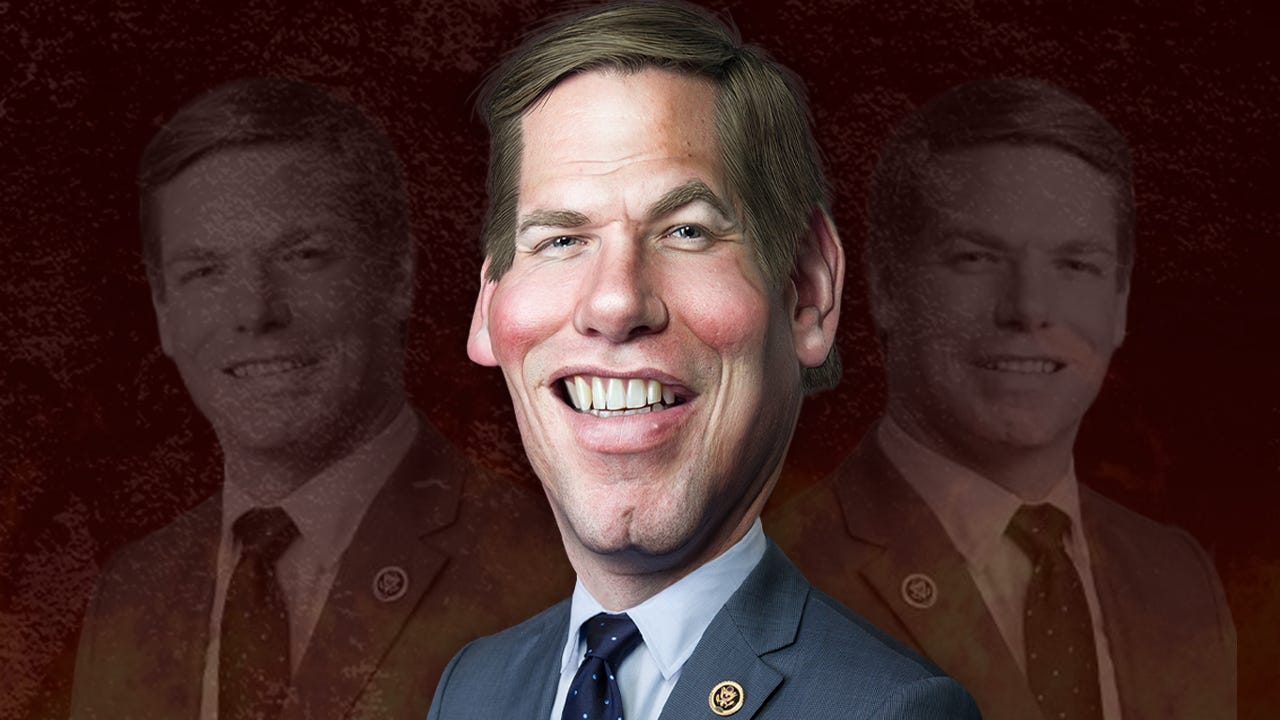
If ambition could be decanted in a laboratory flask, aerated with vanity, sprayed with hair product, and marched directly from student government into a television studio, the result would look very much like Eric Swalwell. Born in Sac City, Iowa, and raised in Dublin, California, Swalwell was the son of a police officer and grew up in a household that seems to have prized order, respectability, advancement, and the polished appearances of upward mobility. He played sports, pursued the usual credentials, studied law, and followed that now drearily familiar route by which modern mediocrities are transformed into public men. Student government. Local office. Prosecutor’s résumé. Camera ready presentation. Poll tested indignation. He did not enter public life with the gravitas of a statesman, the scars of a soldier, the daring of an entrepreneur, or the intellectual distinction of a serious thinker. He arrived as something more synthetic, more curated, more focus grouped. He looked less like a leader than like a prototype assembled by consultants for the age of cable news.
Swalwell first entered politics through the Dublin City Council, a suitably modest launching pad for a career that would later become a monument to immodesty. In 2012 he challenged veteran Democratic Congressman Fortney Pete Stark, one of the more eccentric and abrasive old bulls of the House. Stark was not always graceful, but he was unmistakably real. He was cantankerous, unvarnished, often undisciplined, and entirely himself. Swalwell, by contrast, was the fresh packaging, the youthful substitute, the glossy showroom model rolled forward for voters eager to confuse youth with virtue and polish with depth. In an era already infatuated with optics over substance, the new package beat the old original. That was the beginning of Eric Swalwell’s ascent, and it was also, in retrospect, the first act in a political comedy of hypocrisy so broad that even Aristophanes might have rejected it as implausible.
Swalwell did not merely run against Pete Stark. He attacked Stark on residency grounds. He made an issue of whether Stark truly lived in the district, whether he genuinely maintained a domicile there, whether he authentically belonged among the people he purported to represent. Swalwell wrapped himself in the language of local rootedness and territorial legitimacy. He presented himself as the man who actually lived there, actually belonged there, and actually represented the district not merely by legal technicality but by physical and civic presence. It was an effective line of attack. It helped propel him to victory. It gave him the moral posture of reform and the tactical advantage of indignation. But politics has a wicked sense of humor, and it often reserves its cruelest punch lines for those who declaim most piously.
Years later, extensive coverage erupted over Swalwell’s own domicile, his own residency, his own connection to California, and his own mortgage documents tied to Washington. The very cudgel he once used against Pete Stark came flying back toward his own forehead.
That irony is too rich to pass over quickly, because it says almost everything one needs to know about the man. When Swalwell sought the governorship of California, his eligibility became the subject of scrutiny and challenge amid allegations that he did not in fact maintain the sort of California domicile the office required. Questions swirled around his life in Washington, his use of a District of Columbia residence, and mortgage paperwork that reportedly described him as a DC resident. His candidacy was formally challenged on residency grounds and yet was ultimately allowed to proceed. The courts may have kept him on the ballot, but a legal ruling does not erase a political humiliation. The spectacle remained devastating. The man who rose in part by attacking Pete Stark for not truly living in the district found himself defending his own ties to the state he wished to govern. That is not a mere inconsistency. That is a farce of almost Shakespearean symmetry, with the added vulgarity of mortgage documents.
Once installed in Congress, Swalwell discovered the great secret of modern political advancement. Policy is slow. Governing is tedious. Legislative craftsmanship is obscure. But television rewards preening instantly. Cable news became his natural habitat because it rewarded not wisdom but performance, not seriousness but volume, not discernment but insinuation. Why labor over complex legislation when one can rush before a camera, arrange one’s face into theatrical alarm, and accuse one’s enemies of treachery? Swalwell became one of the most tedious fixtures of the anti Trump pageant, a man perpetually available for outrage, forever sprinting toward the nearest microphone with the urgency of a courtier desperate not to miss the royal banquet. He repeatedly insinuated that Donald Trump, Trump’s associates, and yes, yours truly, were compromised by Russia. He trafficked in the suggestion that I was a Russian asset, which was not merely false but ludicrous, the sort of smear that only a political culture marinated in hysteria could entertain for even a moment. He delivered such accusations with the smug assurance of a man who knew the press would applaud the charge and never demand the proof.
Then came Christine Fang, also known as Fang Fang, and with her one of the most delicious reversals in recent American political life. Axios reported that a suspected Chinese intelligence operative cultivated relationships with local and national politicians in California between 2011 and 2015, and that Swalwell was among those in her orbit. Fang fundraised, networked, attended events, and sought proximity to rising political figures. Swalwell later said he was shocked when the FBI briefed him and that he cut off contact. He has not been charged with wrongdoing in that matter. Fine. Let that be noted. But let the more important political truth be noted as well. The same man who had spent years clanging the bells of foreign compromise, flinging around accusations of Russian influence like confetti at a parade, found his own political circle penetrated by a suspected Chinese operative. One could scarcely write a more savage irony if one were drafting a political farce for the stage. The self appointed bloodhound of foreign infiltration became the butt of a scandal involving an alleged Chinese communist asset. Hypocrisy in Washington is common. On rare occasions it ripens into high art. This was one of those occasions.
Still, Washington protected him. That is one of the capital’s oldest habits. If a public figure remains useful to the correct faction, his embarrassments are softened, his scandals contextualized, his contradictions explained away as misunderstandings, and his humiliations padded with euphemism. Swalwell remained useful. He was a dependable anti Trump voice. He was photogenic enough for television. He was belligerent enough for partisan warfare. He had the dead eyed confidence of a man who mistakes a green room for a moral calling. So the press cushioned him. The party tolerated him. The machine kept turning. He continued his cable appearances, his solemn monologues, his prepackaged fury, his lectures on national security and civic decency, as if the Fang episode had not already made a mockery of his most cherished public persona.
But character has a way of collecting debts, and in time those debts come due with interest. The event that finally brought Eric Swalwell down was not the Fang scandal, not the residency embarrassment, and not his long record of sanctimony. It was the eruption of serious allegations of sexual misconduct and sexual assault during his gubernatorial campaign in 2026. According to reports cited by the Associated Press and Reuters, a former staffer accused Swalwell of sexually assaulting her on two occasions, including one alleged incident in a New York hotel in 2024 when she said she was too intoxicated to consent. CNN also reported additional allegations from other women, including claims involving unsolicited explicit messages or photos and other inappropriate conduct. Swalwell denied the most serious accusations. Reuters reported that he called them “absolutely false.” He also publicly acknowledged what he called “mistakes in judgment.” But by then the political avalanche had already begun.
This, then, is the point that cannot be blurred, softened, or passed over with vague euphemism. What brought Swalwell down was a cascading scandal of sexual misconduct allegations that detonated while he was running for governor of California. The allegations did not remain abstract whispers. They triggered concrete consequences. The Manhattan District Attorney’s (DA) office opened an investigation into one of the alleged assaults. The House Ethics Committee opened a probe as well. Democratic allies who had once praised his brilliance and future suddenly discovered the exquisite moral usefulness of distance. Endorsements vanished. Campaign chairs resigned. Support within the party collapsed with shocking speed. Adam Schiff withdrew his endorsement. Nancy Pelosi and other prominent Democrats urged that the matter be taken seriously. Over fifty former staffers reportedly called for his resignation. The same political class that had once treated Swalwell as a youthful lion of the resistance began to treat him as if he were radioactive waste in a tailored suit.
Swalwell first insisted he would stay in the race. Then he suspended his gubernatorial campaign. The Associated Press and Reuters both reported that he stepped back from the California race as the allegations mounted and as support evaporated around him. The San Francisco Chronicle reported that, because of filing deadlines, his name would still appear on the ballot even after his campaign ended. That is a fitting final indignity for a politician who spent so much of his life worshipping image. Even in withdrawal, the ghost of the candidacy lingered there on the ballot, a spectral reminder of an ambition that had outrun its own moral scaffolding.
Then came the final collapse. On April 13, 2026, Swalwell announced that he would resign from Congress. The Associated Press reported that his resignation came amid mounting pressure, after the House Ethics Committee opened its probe and after bipartisan calls for his departure intensified. Reuters likewise reported that he chose to quit under the weight of the allegations and the political turmoil they had unleashed. So let there be no ambiguity. He did not simply endure an embarrassing news cycle. He did not merely lose a few endorsements. He did not only suspend a campaign. He resigned from Congress itself after the allegations, after the investigation, after the withdrawal of support, after the moral posturing had finally boomeranged into personal catastrophe.
There is a grim and almost mathematical beauty in the pattern. Eric Swalwell accused others of foreign compromise while his own orbit was tainted by scandal involving a suspected Chinese operative. He climbed over Pete Stark by attacking questions of domicile and residence, only to face his own residency controversy when he sought the governorship. He built a career around accusation, innuendo, and televised moral superiority, only to find himself accused, investigated, abandoned, and finally toppled. He loved scrutiny when it was directed outward. He recoiled from it when it turned inward. He treated slander as a political instrument, mockery as an argument, and performance as substance. In the end, performance could not save him, cameras could not cleanse him, and the applause of partisans could not protect him.
Swalwell was never merely partisan. Many politicians are partisan. He was something more irritating and more revealing. He was smug. He was glib. He was one of those insufferable public men who mistake media validation for virtue and social media momentum for history’s blessing. He represented the worst habits of our degraded age, an age in which a man can become nationally famous not for building anything admirable, defending anything noble, or discovering anything true, but for appearing repeatedly on television with an expression of caffeinated moral alarm. He became a mascot for a whole class of ambitious mediocrities who rise not through greatness but through shamelessness, not through statesmanship but through a kind of lubricated opportunism that passes for sophistication among the permanently online and the permanently partisan.
And that is why his fall resonates beyond the man himself. The rise and fall of Eric Swalwell is not merely the story of one congressman brought low. It is the story of a political culture that manufactures these figures by the dozen, inflates them with media oxygen, armors them with partisan indulgence, and then feigns astonishment when they explode under pressure. He was an emissary of the age of insinuation. He was one of the little princes of the anti Trump circus. He made himself prosecutor, lecturer, inquisitor, and executioner. He repeatedly cast himself as the arbiter of who was compromised, who was indecent, who was dangerous, and who was disqualified from public life. Yet in the end, he became what he most relished making of others.
An exhibit.
A cautionary tale.
A man who attacked Pete Stark for not truly living in the district and then had to defend his own domicile.
A man who denounced foreign compromise while living under the long shadow of Fang Fang.
A man who built his public identity on accusation and then found himself cornered by allegations he could not politically survive.
A man inflated by cameras and punctured by facts.
His rise was swift because the age was shallow.
His fall was inevitable because vanity is brittle.
The spotlights dimmed. The applause ceased. The cultivated smirk that once flashed so confidently across television panels now survives only as a relic of a political career undone by its own contradictions. Eric Swalwell wanted to be prosecutor, moral lecturer, and executioner of his enemies. Instead, history has reduced him to something much smaller and much sadder. He became the defendant in the court of public contempt.
Brilliant writing!
Cicero said "politicians aren’t born, they are excreted", and Eric Swalwell is a case in point.