


Memorial Day is not a holiday. It is not merely the unofficial beginning of summer. It is not a day for mattress sales, beach traffic, backyard cookouts, beer coolers, or retail promotions wrapped in red, white, and blue bunting.
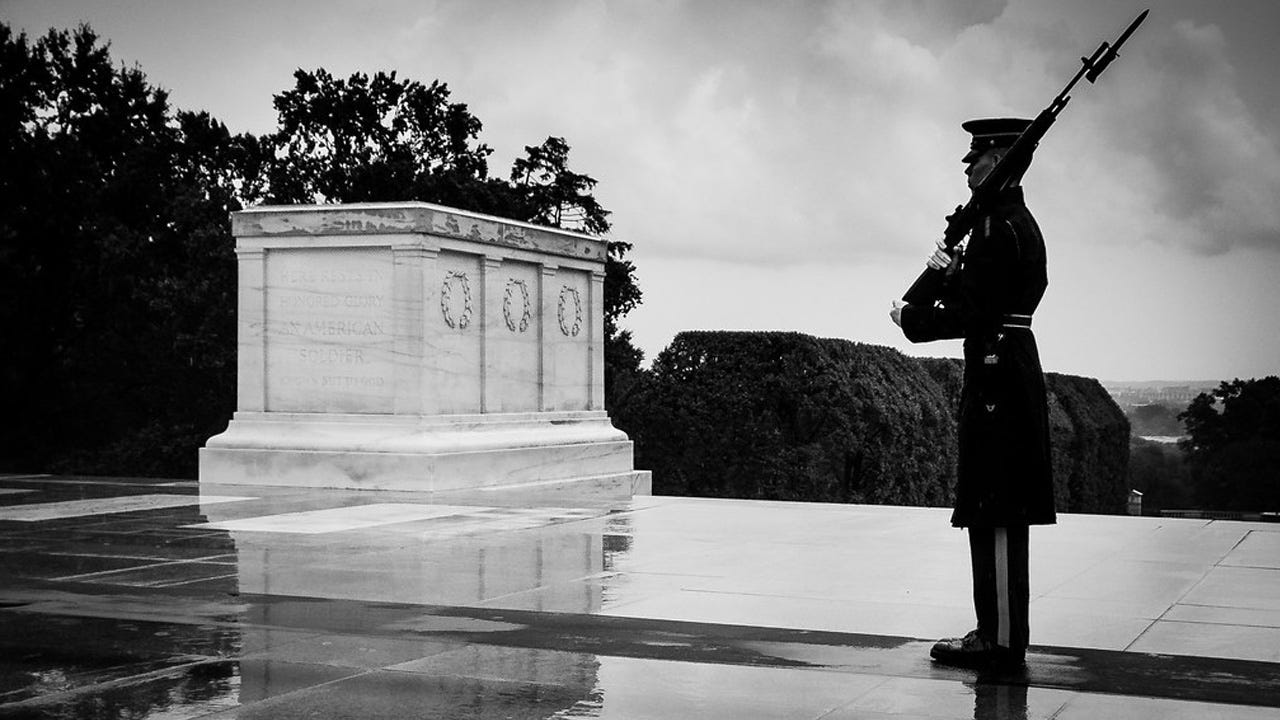
For millions of Americans, Memorial Day is the worst day of the year. It is the day a mother stares at a folded flag inside a mahogany box. It is the day a widow runs her fingers across the cold marble of a grave at Arlington National Cemetery. It is the day a son remembers the father he barely knew except through medals, photographs, and stories whispered through tears.
Memorial Day is a sacred day of remembrance consecrated by blood, grief, sacrifice, and duty. It is a day when America must bow her head before the altar of the fallen and remember that freedom is not free.
Freedom is purchased in flesh and blood by young Americans who climbed hills under machine gun fire, stormed beaches under artillery barrages, flew burning aircraft into enemy skies, froze in foxholes, drowned in distant seas, and marched into battle knowing they may never return home again.
The story of Memorial Day begins not in comfort but in catastrophe. Its origins were born from the smoldering ashes of the American Civil War, the deadliest conflict ever fought on American soil. The first formal Memorial Day observances emerged when grieving Americans decorated the graves of Union soldiers with flowers in what became known as Decoration Day. Yet the true roots of American sacrifice stretch back even further to Lexington and Concord on April 19, 1775 when a colonial militia stood before the most powerful empire on earth, The British Empire, and answered tyranny with musket fire. Ralph Waldo Emerson later immortalized that first exchange as “the shot heard round the world,” because it was not merely the beginning of a revolution. It was the birth of an idea unlike any other in human history. America was founded upon the radical belief that our rights come from God, not kings, not governments, not bureaucracies, and not tyrants.
That idea has been defended ever since by generations of American warriors whose courage forged the republic in every era of danger and uncertainty. The first Americans to die under the flag of the United States fell during the Revolutionary War. Approximately 4,435 American soldiers were killed in combat during the Revolution, while more than 25,000 died overall from disease, exposure, imprisonment, and deprivation. The Continental Army bore the overwhelming burden, though colonial militias and early naval forces also suffered losses.
Shortly after independence, America confronted the Barbary Wars, conflicts many modern Americans barely remember but which shaped the nation’s understanding of sovereignty and military power. The Barbary Wars were fought against North African pirate states including Tripoli, Algiers, Tunis, and Morocco, whose rulers kidnapped sailors, enslaved Christians, hijacked merchant ships, and extorted tribute payments from Western nations. European powers often paid the pirates for safe passage. America refused. Thomas Jefferson understood that a republic unwilling to defend itself would soon cease to exist. During the First Barbary War from 1801 to 1805, approximately 35 Americans were killed in battle, primarily sailors and Marines. Total deaths were roughly 74. The Second Barbary War in 1815 resulted in approximately 4 battle deaths and roughly 138 total deaths. These early conflicts cemented the United States Navy and Marine Corps as guardians of American commerce and freedom abroad.
The War of 1812 followed, often called “America’s Second War for Independence”. British forces burned their way through Washington, D.C. while American soldiers and sailors fought desperately to preserve the young republic. Approximately 2,260 Americans were killed in battle and roughly 15,000 died overall, most from disease. The Army accounted for approximately 1,950 battle deaths, while the Navy lost around 265 personnel and the Marine Corps lost roughly 45.
The Mexican-American War from 1846 to 1848 expanded the United States across the continent but came at terrible cost. Approximately 1,733 Americans were killed in battle and more than 13,000 died overall. The Army suffered nearly all battle casualties while Marines and Navy personnel also perished in combat operations.
Then came the American Civil War, the great national crucible that nearly destroyed the republic entirely. Brother fought brother. Entire towns lost their young men in a single afternoon. More than 655,000 Americans died overall, including approximately 215,000 battle deaths between Union and Confederate forces. The overwhelming majority served in the Army while naval losses were significantly smaller. The Civil War remains the deadliest conflict in American history because Americans killed other Americans on an industrial scale never before seen on this continent.
After the Civil War came the Indian Wars, frontier conflicts, interventions, and overseas operations. Thousands more Americans died during campaigns against hostile tribes, during the Seminole Wars, and in smaller military expeditions that secured and expanded the nation. The Boxer Rebellion in China claimed approximately 68 American battle deaths. The Spanish American War in 1898 cost approximately 385 battle deaths and roughly 2,446 total deaths. The Philippine American War that followed claimed approximately 1,020 battle deaths and more than 4,000 total deaths.
World War I introduced America to trench warfare, mustard gas, machine guns, and industrialized death on a horrifying scale. More than 53,000 Americans were killed in battle and over 116,000 died overall. The Army and American Expeditionary Forces bore the brunt of combat losses while the Navy and Marine Corps also sustained significant casualties.
World War II transformed the entire planet into a furnace of violence. The United States lost approximately 291,557 battle dead and more than 405,000 total military personnel. The Army and Army Air Forces suffered more than 318,000 deaths. The Navy lost more than 62,000. The Marine Corps lost more than 24,000. The Coast Guard lost nearly 2,000. Young Americans crossed oceans to storm Normandy, fight through the jungles of the Pacific, liberate concentration camps, and destroy fascism and Japanese militarism. Entire cemeteries across Europe and Asia now stand as eternal monuments to American sacrifice.
The Korean War followed only five years later. Often called “The Forgotten War”, Korea has been tragically overshadowed between the monumental shadow of World War II and the trauma of Vietnam. Yet the men who fought at Inchon, Chosin Reservoir, and along the frozen Korean Peninsula displayed extraordinary courage under unimaginable conditions. Approximately 33,700 Americans were killed in battle and more than 36,000 died overall. The Army suffered the majority of losses while Marines endured catastrophic casualties during some of the war’s fiercest fighting. Korean War veterans deserve far greater recognition than history has often afforded them.
Vietnam became one of the most painful chapters in modern American history. Approximately 58,220 Americans died during the conflict, including roughly 47,000 battle deaths. The Army lost more than 38,000. The Marine Corps lost nearly 15,000. The Navy and Air Force each lost thousands more. Young American men fought bravely in jungles, villages, and rice paddies against a ruthless communist insurgency. Yet when many returned home, they were not greeted as heroes. Some were cursed at, humiliated, and even spit upon by radical antiwar activists poisoned by self hatred and left wing propaganda. Those Vietnam veterans deserved parades, gratitude, and reverence. Instead many received contempt from the very nation they risked their lives to defend. It remains one of the great moral disgraces of modern American society. In fact, President Trump personally and very quietly financed the Vietnam Veterans “Welcome Home” parade in New York City on May 7, 1985 with a one million dollar endowment as well as raised additional funding and served as co-chairman of the New York Vietnam Veterans Memorial Commission appointed by Mayor Ed Koch.
The Cold War carried America into Lebanon, Grenada, Panama, Somalia, and countless covert and conventional operations around the globe. Then came the Gulf War, where approximately 294 Americans died, including roughly 149 to 288 battle deaths depending on classification. Then came the Global War on Terror after September 11, 2001.
In Afghanistan, approximately 2,325 Americans died, including nearly 1,900 battle deaths. In Iraq, more than 4,492 Americans died with battle deaths ranging between approximately 3,500 and 4,400 depending upon classification. Thousands more returned home wounded physically and psychologically, carrying scars invisible to the naked eye but permanent upon the soul.
America’s military sacrifices extend beyond combat alone. Training accidents have claimed enormous numbers of American lives. During World War II alone, approximately 15,000 American airmen died in training accidents before they ever saw combat. From 2006 through 2021, more than 5,600 active duty personnel died in training mishaps and accidents. Since 1980, tens of thousands of military accident deaths have occurred, many during exercises intended to prepare Americans for combat. Every one of those lives mattered. Every one represented a son, daughter, husband, wife, or friend who raised their hand and volunteered to serve the United States of America.
Today, according to the Defense POW MIA Accounting Agency, approximately 80,000 to 83,000 Americans remain unaccounted for from World War II, Korea, Vietnam, the Cold War, and other conflicts. Roughly 71,000 remain missing from World War II alone. Approximately 7,300 remain missing from Korea. More than 1,500 remain missing from Vietnam. Some were prisoners of war. Some were lost at sea. Some vanished behind enemy lines. Many families never received answers. Yet America continues searching for them because this nation understands a sacred principle. We do not abandon our dead.
The total number of Americans who have died for our freedoms and liberty is approximately 1.3 million men and women. They came from every race, creed, religion, state, and economic background. Farmers from Iowa. Steelworkers from Pennsylvania. Ranchers from Texas. Fishermen from Maine. Coal miners from West Virginia. Immigrants who barely spoke English but loved the American flag with all their hearts. They stood together beneath one flag because being an American is not an accident of geography. It is a gift from God.
The United States is not perfect because no nation created by imperfect men can ever be perfect. Yet there has never been another nation in human history that has done more to advance liberty, self government, individual rights, human dignity, correct our wrongs, and opportunity. Americans liberated Europe from fascism. Americans rebuilt Japan and Germany instead of enslaving them. Americans defended South Korea from communist annihilation. Americans protected shipping lanes, rescued allies, fed starving nations, and carried the burden of defending the free world for generations.
The men and women we honor on Memorial Day did not die for politicians. They did not die for bureaucracies. They did not die for fashionable ideologies or social experiments. They died for the enduring promise of America itself. They died so future generations could worship freely, speak freely, vote freely, raise families freely, and live beneath the blessings of liberty secured by the Constitution and endowed by Almighty God.
When you stand before a military cemetery this Memorial Day understand what you are truly witnessing. You are standing in the presence of Americans whose legacies are written not in speeches, headlines, or monuments alone, but in sacrifice itself. Their names are etched into white marble crosses and Stars of David stretching to the horizon like an army still standing watch over the republic they died to preserve. Their legacies are enshrined in nothing other than their own blood and is their gift to us. Don’t squander it.
Stand before Arlington, Normandy, or any small-town veterans’ cemetery and the slogans die. What remains is the truth: America was preserved by sacrifice. Farmers, steelworkers, immigrants, ranchers, coal miners, sailors, Marines, soldiers, airmen, and guardsmen gave everything so the rest of us could worship, speak, work, vote, raise families, and argue freely. The Left teaches shame. The graves teach gratitude. The anti-American academy says our history is oppression. The dead answer with liberation, courage, and duty. Memorial Day asks one question: Will we remain worthy of them? Fly the flag. Teach the children. Keep faith with the fallen.
Too many people these days have no respect for those who died, at times giving all they possibly could so that others can have the freedom to live.
I personally believe that it’s the parents responsibility to teach their children to respect and honour others especially those who have died.