


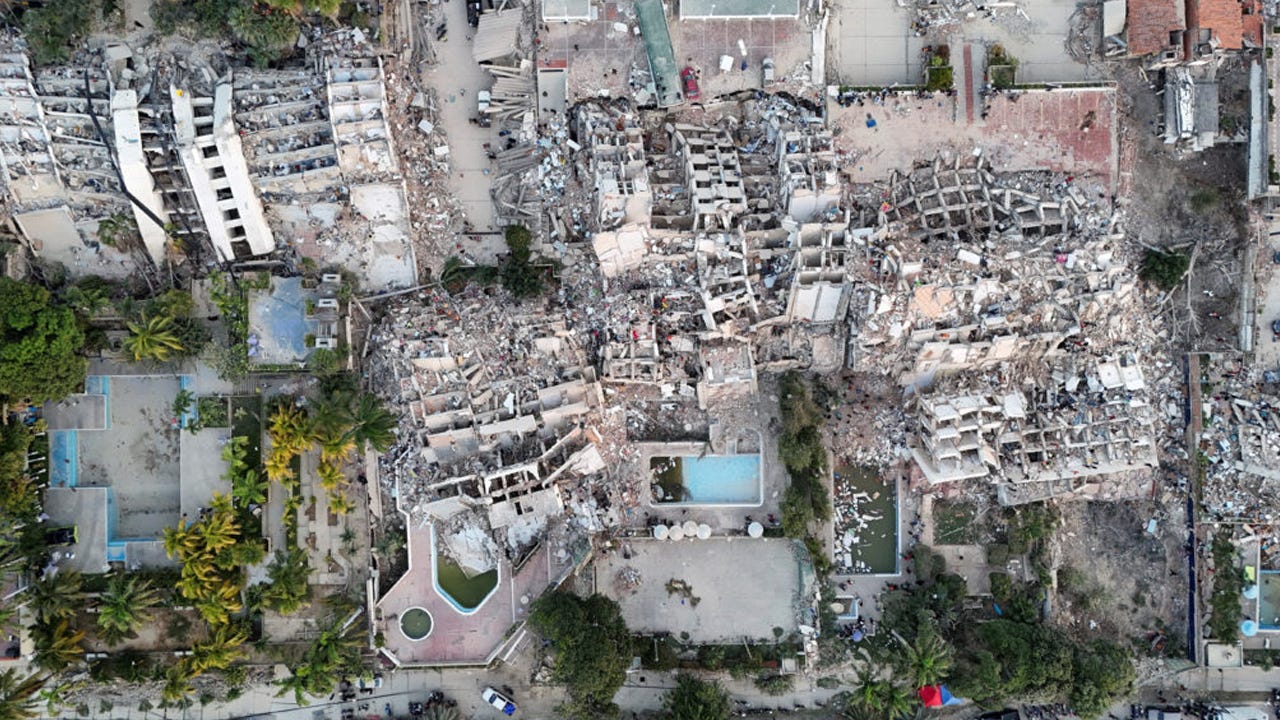
The twin earthquakes that struck Venezuela on June 24, 2026 did far more than reduce buildings to rubble. They exposed the tragic consequences of decades of governmental neglect, corruption, and ideological misrule. Nature delivered the tremors, but it was the Venezuelan state that transformed a natural disaster into a national catastrophe. The heartbreaking images emerging from Caracas, La Guaira, and the surrounding communities tell a story that extends far beyond seismic activity. They tell the story of a government that failed to prepare its nation, failed to protect its citizens, and then struggled to rescue them after disaster struck.
Acting President Delcy Rodríguez quickly declared a national state of emergency, formed commissions, closed schools, deployed military personnel, and appealed for international assistance. These actions made for impressive headlines, but they could not conceal the grim reality unfolding on the ground. Residents in some of the hardest hit neighborhoods reported waiting days before organized government rescue teams arrived. Families dug through mountains of shattered concrete with their bare hands while volunteers improvised rescue operations using whatever tools they could find. In numerous communities, ordinary Venezuelans became first responders because the government simply was not there.
The contrast between official statements and reality could not have been more striking. While government officials spoke of coordination and recovery, survivors publicly confronted Rodríguez during visits to damaged neighborhoods, demanding heavy equipment, ambulances, medical supplies, and rescue personnel. Those desperate pleas reflected years of accumulated frustration rather than merely the immediate aftermath of an earthquake. The disaster simply magnified failures that had existed for decades.
Ironically, it was not Venezuela’s government that mounted the largest and most effective rescue operation. It was the international community. The United States rapidly deployed Disaster Assistance Response Teams, Urban Search and Rescue units, aircraft, search dogs, engineers, and medical personnel while committing more than $150 million in emergency assistance. American teams were among the first international responders arriving within the first 24 hours after the disaster, working continuously to locate survivors trapped beneath collapsed buildings.
Colombia likewise mobilized rescue personnel and emergency medical teams almost immediately, reflecting the improving relationship between Bogotá and Caracas following recent political changes. Mexico dispatched specialized urban search and rescue teams, engineers, heavy rescue equipment, and canine units, arriving within approximately forty eight hours of the disaster. El Salvador and the Dominican Republic also sent military personnel, rescue specialists, aircraft, and humanitarian supplies during the first two days following the earthquakes.
European nations joined the effort as well. Spain, France, Germany, Switzerland, Italy, and other members of the European Union activated specialized rescue teams through the European Civil Protection Mechanism while deploying firefighters, emergency medical professionals, structural engineers, and satellite imaging specialists. India contributed a fully operational field hospital along with dozens of tons of humanitarian supplies. The United Nations coordinated hundreds of international responders, while organizations such as the Red Cross, Catholic Relief Services, Direct Relief, Samaritan’s Purse, and World Central Kitchen provided desperately needed medical assistance, shelter, food, and clean drinking water. The Vatican also extended humanitarian assistance while Pope Leo XIV publicly prayed for the victims and praised the courage of rescuers risking their lives to save strangers trapped beneath the ruins.
The fact that so much of the life saving effort originated outside Venezuela raises an uncomfortable but unavoidable question. How could one of the most resource rich nations on Earth become so incapable of helping its own people? The answer lies in decades of socialist mismanagement and institutional decay. Venezuela possesses the largest proven oil reserves on the planet. At one time, it was among the wealthiest countries in Latin America. Its oil revenues should have financed world class highways, hospitals, bridges, electrical grids, emergency response systems, and earthquake resistant infrastructure. Instead, vast sums of petroleum wealth disappeared into corruption, political patronage, state monopolies, and ideological experiments that devastated the nation’s productive economy.
Beginning under Hugo Chávez and continuing under Nicolás Maduro, the Venezuelan government increasingly centralized economic control while nationalizing industries, driving away private investment, and hollowing out professional institutions. Oil revenues that should have been invested in maintaining infrastructure were instead diverted toward unsustainable political programs, subsidies, and projects designed to consolidate political power. Engineers, architects, doctors, scientists, and skilled professionals fled the country in one of the largest brain drains in modern history, leaving Venezuela with fewer qualified experts capable of maintaining critical infrastructure or responding to emergencies.
The consequences became horrifyingly apparent after the earthquakes. Many buildings that collapsed had never been retrofitted to comply with modern seismic engineering standards developed after the devastating 1967 Caracas earthquake. Numerous residential towers and apartment complexes constructed during successive oil booms were built with inadequate concrete, insufficient steel reinforcement, weak structural connections, and poor quality control. Engineers have pointed to deficient beam and column construction, inadequate seismic detailing, and cost cutting measures that prioritized political deadlines over public safety.
Some reports even describe residential buildings containing shockingly substandard materials that should never have been used in earthquake prone regions. These deficiencies were not accidents. They reflected a political system in which contracts frequently rewarded loyalty rather than competence, while independent oversight steadily disappeared.
The government’s failure to modernize infrastructure becomes even more difficult to defend when one considers Venezuela’s extraordinary natural wealth. Countries with far fewer resources, including Chile and Japan, have invested heavily in earthquake resistant construction, strict building code enforcement, emergency preparedness, and continuous infrastructure modernization. Their earthquakes often produce tragic losses, but modern engineering prevents countless additional deaths.
Venezuela chose a different path. Rather than investing billions in resilient infrastructure, successive governments allowed bridges, highways, hospitals, electrical grids, water systems, and public housing to deteriorate. Corruption diverted maintenance funds. Inflation destroyed purchasing power. International sanctions compounded existing problems but did not create them. By the time the earthquakes struck, much of Venezuela’s infrastructure had already been weakened by years of neglect.
Even the emergency response suffered from those same failures. Hospitals lacked sufficient equipment. Ambulances were scarce. Heavy rescue machinery was unavailable in many locations. Fuel shortages complicated transportation. Electrical failures disrupted communications precisely when coordination was most essential. Every existing weakness multiplied the destructive effects of the earthquakes.
History repeatedly demonstrates that natural disasters expose the true condition of governments long before the earth begins to shake. The 1906 San Francisco earthquake ultimately led to stronger building codes. Japan rebuilt after successive earthquakes with relentless engineering discipline. Chile transformed painful lessons into some of the world’s strongest seismic standards. Great nations learn from catastrophe before the next disaster arrives. Venezuela, tragically, spent decades ignoring those lessons despite possessing the financial means to implement them.
The courage displayed by ordinary Venezuelans deserves worldwide admiration. Neighbors rescued neighbors. Volunteers distributed food and water. Churches opened their doors. Medical workers continued treating patients despite collapsing facilities and limited supplies. International rescue teams demonstrated extraordinary professionalism and compassion. The heroes of this tragedy were not politicians holding press conferences. They were ordinary citizens and rescuers working through exhaustion to save lives.
Ultimately, the earthquakes did not merely destroy buildings. They exposed the accumulated consequences of decades of governmental failure. Oil wealth alone cannot guarantee prosperity. Natural resources cannot substitute for honest institutions, competent leadership, sound engineering, and respect for the rule of law. When governments neglect those fundamental responsibilities, the bill eventually comes due. For far too many Venezuelan families, that bill arrived beneath mountains of concrete and steel.
The US should take heed and remember it. The corruption runs deep in our country and our system has begun a spiral towards a similar destruction. Allowing our country to fall into unAmerican and unconstitutional patterns is leading our own country down the wrong path. We need to wake up and stop the snowball we are creating here.
Disasters do not treat every country equally because governments matter. Engineering matters. Honest contracting matters. Building codes matter. Hospitals, ambulances, ports, roads, fuel, communications, and trained rescue teams matter. Chile and Japan learned from earthquakes and built discipline into their systems. Venezuela had oil wealth and squandered it on patronage, ideology, corruption, and control. The heroes now are not the politicians holding press conferences. They are neighbors, church volunteers, doctors, rescuers, and foreign teams pulling life from concrete. The lesson is brutal: natural resources cannot save a nation whose institutions have rotted. Socialism did not cause the quake. It magnified the ruin.