


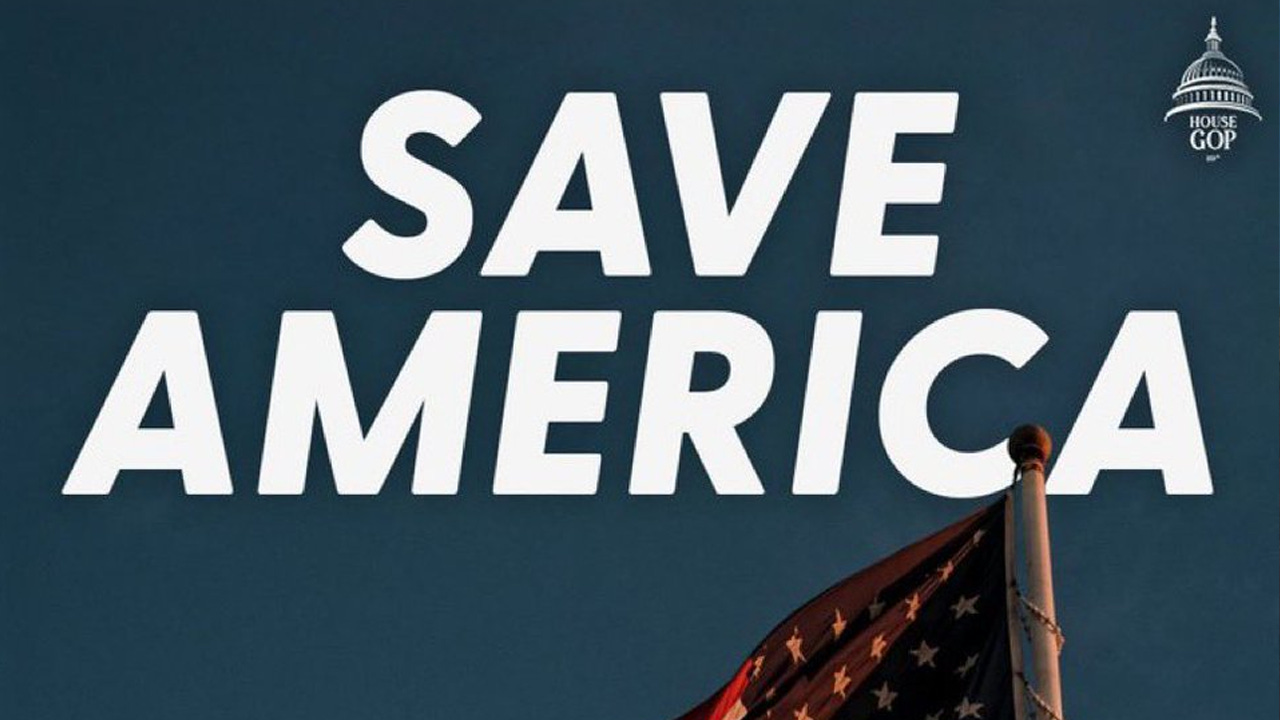
The American Republic stands today at a civilizational crossroads, suspended between ordered liberty and administrative anarchy, between a constitutional architecture painstakingly erected by geniuses and a creeping entropy imposed by ideological opportunists who prefer procedural murkiness to transparent law. The SAVE America Act emerges in this moment not as a partisan bauble but as a civilizational instrument, a keystone placed beneath a sagging arch to prevent the entire structure from collapsing into historical oblivion.
What is the SAVE America Act if not a reaffirmation of first principles? What is citizenship if not the sacred threshold that separates participant from spectator in the grand drama of self government? What is a vote if not a sacrament of sovereignty, a solemn attestation that the individual casting it is a lawful member of the political body?
The SAVE America Act, formally titled the Safeguard American Voter Eligibility Act, was introduced in early February 2026 during the 119th Congress by Congressman Chip Roy of Texas, with corresponding efforts led in the Senate by Senator Mike Lee of Utah. It builds upon earlier incarnations of the SAVE Act, which successfully passed the House in prior sessions but stalled in the Senate labyrinth, a familiar graveyard where common sense reforms often go to languish.
Which bodies of Congress have previously acted on similar SAVE legislation? The United States House of Representatives has already demonstrated its willingness to advance this reform in earlier versions. Which bodies must still act for the SAVE America Act to become law? The Senate must pass it, and the relevant committees in both chambers, including those overseeing election administration and constitutional affairs, must complete their review and reporting process.
At its core, the SAVE America Act amends the National Voter Registration Act of 1993 to require documentary proof of United States citizenship when an individual registers or updates registration for federal elections. This is not radical. This is not exotic. This is not draconian. It is the equivalent of requiring a ticket before boarding a train.
Acceptable documentation includes a REAL ID compliant identification indicating citizenship, a valid United States passport, a military identification paired with service records showing United States birth, and other government issued photo identifications confirming citizenship. States would be required to verify citizenship before accepting registrations and to maintain ongoing programs ensuring that only citizens remain on voter rolls.
Recent versions also emphasize a nationwide photo identification requirement for federal elections, stricter standards for mail in voting, and the creation of pre election citizenship confirmation systems. These provisions are not instruments of exclusion. They are instruments of clarification.
The Republic is not a house of mirrors. This populace is not conducting a séance where invisible hands shuffle ballots behind closed curtains. It is a courthouse, not a carnival.
President Donald Trump has publicly endorsed the SAVE America Act, framing it as an essential pillar in a broader effort to nationalize baseline election standards, require voter identification, and curtail the industrialization of mail in voting except in narrow and legitimate circumstances such as military service or serious illness. Why would a nation that requires identification to board an airplane, rent a car, open a bank account, or purchase certain medications refuse to require identification to choose its leaders?
Opponents argue that noncitizen voting is rare. Even if one accepts that claim at face value, what is rare still becomes catastrophic when multiplied across a nation of more than three hundred million souls. A hairline fracture in a dam is still a fracture. A single spark in a dry forest is still a fire.
They claim that documentation requirements burden eligible voters. Yet millions of Americans already possess the very documents contemplated by the Act. For those who do not, the solution is not to abolish standards, but to facilitate access to documentation. The answer to a missing lock is not to leave the door open.
The SAVE America Act would improve life for all Americans by restoring confidence in elections, the lifeblood of any functioning Republic. Without confidence, participation withers. Without participation, legitimacy decays. Without legitimacy, power devolves into raw coercion.
When citizens believe the system is honest, they reengage. When they reengage, communities stabilize. When communities stabilize, economies grow. When economies grow, families thrive. Election integrity is not an abstraction. It is the soil from which prosperity grows.
The Act also reduces administrative chaos. Clean voter rolls mean fewer provisional ballots, fewer legal disputes, fewer recounts, fewer courtroom melodramas that stretch for months like constitutional purgatories. Clarity is cheaper than confusion. Order is cheaper than litigation. Truth is cheaper than theater.
The SAVE America Act is a bright lantern in a long dark tunnel. It is a compass in a bureaucratic blizzard. It is a constitutional tuning fork restoring harmony to an orchestra that has drifted into discordant noise.
Do Americans deserve elections that are transparent, verifiable, and grounded in law? Do citizens have the right to know that their votes are not being diluted by ineligible participants? Do we wish to remain a Republic of laws rather than a marketplace of manipulated outcomes? The SAVE America Act answers yes to every one of these questions.
The passage of time teaches that Republics rarely fall in a single dramatic collapse. They erode. They corrode. They soften at the edges until one day they awaken to discover they are no longer what they once were. The SAVE America Act is a conscious act of national self preservation. It does not silence voices. It sanctifies them. It does not shrink democracy. It fortifies the Republic. And for a nation drifting amid fog and faction, that is not merely legislation. That is salvation.
The SAVE America Act is not revolutionary—it’s foundational. Citizenship is the entry point to political sovereignty. If you cannot verify membership in the political body, you cannot sustain confidence in its outcomes. Requiring proof of citizenship to vote in federal elections is not extremism; it’s structural coherence. Every functioning system has thresholds. Banks verify identity. Airlines verify identity. Nations must verify identity at the ballot box. The real danger isn’t asking for documentation—it’s allowing doubts to fester unchecked. A republic survives on legitimacy. Legitimacy survives on clarity. Election integrity isn’t partisan. It’s prerequisite. Results don’t matter if half the country doubts the process.
Seems reasonable. If DEMs are the ones opposing, probably a good idea.