


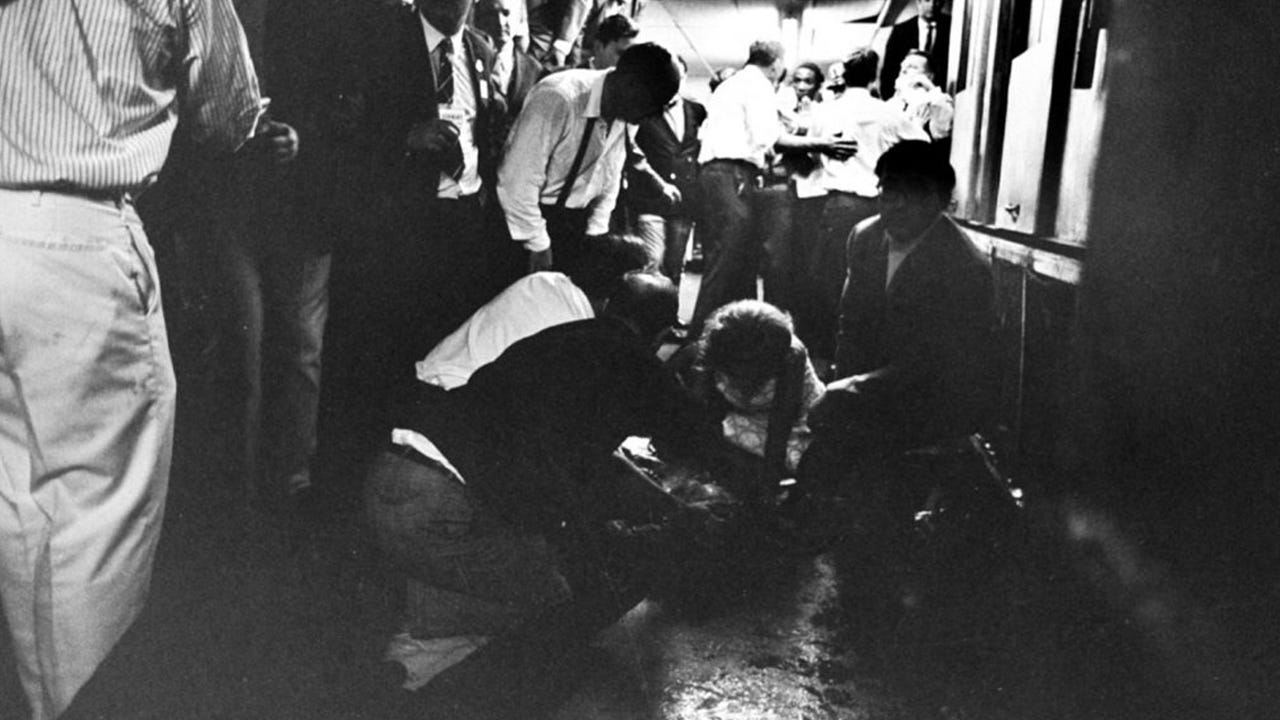
The kitchen in the Ambassador Hotel sounded like a battlefield.
Silver serving trays crashed violently against the floor. Coffee cups shattered.
Steam billowed through the narrow pantry corridors of the Ambassador Hotel in Los Angeles as campaign workers, reporters, waiters, and hotel staff screamed and dove for cover. Men wrestled blindly atop one another in panic while women cried hysterically against the walls.
Robert Francis Kennedy, moments earlier triumphant after winning the California Democratic Presidential Primary, staggered backward in shock as gunfire erupted around him in the cramped hotel pantry shortly after midnight on June 5, 1968.
Then came the scream that would echo through American political history forever: “We shot him! We shot him!”
Multiple witnesses later described a young woman in a white dress with black polkadots fleeing through the hotel corridors alongside a male companion moments after the shooting.
That distinction changes everything.
The Ambassador Hotel was packed that evening because Robert Kennedy had just achieved one of the greatest victories of his political career. California was the crown jewel of the Democratic primary season. Kennedy had delivered his victory speech in the Embassy Ballroom shortly after midnight, celebrating his triumph before supporters, journalists, celebrities, labor leaders, and campaign staff packed into the glamorous old hotel that for decades served as one of Los Angeles’ political and Hollywood nerve centers.
Kennedy intended to leave the ballroom by passing through the hotel kitchen pantry as a shortcut to a press conference area.
He never made it.
Sirhan Sirhan was immediately seized by bystanders after the shooting and quickly presented to the public as the lone assassin. Authorities assured Americans the case was solved within hours. A deranged fanatic had murdered the Democratic frontrunner. Open and shut.
But almost immediately, the official story began collapsing beneath the weight of the evidence itself.
Robert Kennedy did not die that night in the pantry. Gravely wounded, he was rushed to Central Receiving Hospital and later transferred to Good Samaritan Hospital. Surgeons fought desperately to save his life through the night and into the next day. Kennedy lingered for nearly twenty six hours before finally dying in the early hours of June 6, 1968.
But even during those agonizing final hours, bizarre events and unanswered questions swirled around the case.
Reports circulated for decades that President Lyndon Johnson repeatedly called the hospital demanding updates on Kennedy’s condition while shouting to operators, “Is he dead yet? Is he dead yet?”
Other accounts claim members of the Kennedy family sought to bring a renowned Boston brain surgeon to Los Angeles aboard a military aircraft arranged through Hubert Humphrey, only for Johnson to angrily intervene and halt the effort while berating Humphrey for authorizing the flight.
Whether every detail of those stories can ever be conclusively verified or not, they reflect the extraordinary atmosphere of suspicion surrounding every aspect of Robert Kennedy’s death.
And with good reason.
Because the forensic evidence directly contradicts the government’s official narrative.
The central issue is brutally simple.
Sirhan Sirhan was always positioned in front of Kennedy.
Yet Kennedy was shot from behind.
Thomas Noguchi, the highly respected medical examiner who performed the autopsy, reached conclusions that devastate the lone gunman theory. Noguchi determined the fatal shot entered behind Kennedy’s right ear from a distance of approximately one inch. Powder burns and stippling proved the muzzle was pressed extremely close to Kennedy’s head. The bullet traveled upward through the brain from behind. Noguchi also documented additional entry wounds fired from behind at similarly close range.
This matters enormously because witness testimony consistently placed Sirhan several feet in front of Kennedy during the shooting. Witnesses described Sirhan extending his arm outward toward Kennedy from the front before multiple individuals grabbed and restrained him almost instantly.
Photographs confirm this positioning.
Sirhan was never behind Kennedy.
Never close enough to press a revolver within one inch of the back of Kennedy’s head.
Simple 10th grade geometry alone destroys the official story.
A gunman standing in front of Kennedy cannot fire a point blank shot into the back of Kennedy’s skull from behind.
No amount of media repetition changes the laws of physics.
The ballistics problems only deepen from there.
Sirhan’s revolver held eight rounds. Yet audio recordings analyzed over the years by independent experts suggested the possibility that more than eight shots were fired in the pantry. Some acoustic studies identified as many as thirteen distinct shot impulses. Witnesses described rapid overlapping gunfire inconsistent with a single revolver fired while the shooter was being physically restrained.
Investigators also encountered apparent bullet holes in pantry door frames and ceiling panels that did not align with the official trajectory analysis.
Then comes the issue of proximity.
Noguchi’s autopsy proved the fatal shot was fired from virtually direct contact range. Yet witness after witness insisted Sirhan never got close enough to Kennedy to fire from within an inch of his head. Several individuals physically intercepted Sirhan almost immediately after the first shots rang out.
Which raises the obvious question.
Who was behind Robert Kennedy?
One name has haunted independent researchers for decades: Thane Eugene Cesar. Cesar was a security guard standing directly behind Kennedy during the shooting. Unlike Sirhan, Cesar occupied the exact position necessary to match the autopsy findings. He carried a .22 caliber revolver, the same caliber used in the assassination. Witnesses reportedly saw Cesar draw his weapon during the chaos.
Cesar also possessed deeply troubling political views. Researchers later documented that he strongly opposed the Kennedy family, supported segregationist politics, and viewed the Kennedys as dangerous radicals. He worked for a defense contractor tied to sensitive military projects and possessed security clearances that only fueled further suspicion.
Robert F. Kennedy Jr. eventually concluded Cesar likely fired the fatal shot. That conclusion emerged after years of studying the evidence surrounding his father’s death.
In September 2020, Kennedy Jr. appeared on Mike Tyson’s podcast Hotboxin’ alongside Tyson and former NFL player Eben Britton. The interview became one of the most remarkable public conversations Kennedy Jr. has ever given concerning both his father’s assassination and the assassination of President John F. Kennedy.
The discussion ranged across intelligence agencies, the military industrial complex, the Bay of Pigs invasion, civil rights, American democracy, vaccines, and the Kennedy family’s battles with entrenched power structures. Kennedy Jr. spoke openly about what he believes was longstanding hostility between his family and elements of the intelligence establishment.
He declared that evidence of CIA involvement in President Kennedy’s assassination was “incontrovertible.” He argued Lee Harvey Oswald possessed intelligence connections and functioned within a larger covert operation.
Then Kennedy Jr. turned to his father’s murder.
For years, he explained, he accepted the official story regarding Sirhan Sirhan. Only after carefully reviewing the autopsy report, witness testimony, and ballistics evidence did he conclude the government’s narrative was impossible.
Kennedy Jr. emphasized the critical forensic contradiction.
Every shot striking his father entered from behind.
The fatal shot behind the ear came from approximately one inch away.
Sirhan stood in front of Kennedy.
Therefore, Sirhan could not have fired the fatal shot.
Kennedy Jr. specifically identified Thane Eugene Cesar as the individual he believes killed his father. He discussed Cesar’s position directly behind Kennedy during the shooting and criticized authorities for failing to aggressively investigate Cesar or properly examine his firearm despite the glaring inconsistencies in the case.
Kennedy Jr. also discussed Sirhan Sirhan himself, suggesting Sirhan may have functioned as a manipulated patsy or diversion within a broader conspiracy. Sirhan has long claimed he possesses no memory of the shooting itself. Kennedy Jr. expressed support for reexamining Sirhan’s conviction while maintaining Sirhan did not murder his father.
The interview later vanished from major video platforms after discussions involving intelligence agencies and political assassinations generated controversy. Yet copies continue circulating because the interview struck directly at one of the great forbidden questions in American history.
Who really killed Robert F. Kennedy?
The mysterious woman in the polkadot dress only deepens the suspicion.
Multiple witnesses reported seeing her interacting with Sirhan prior to the assassination. Some described her guiding him through the Ambassador Hotel before the shooting. Others recalled her standing near him immediately beforehand.
Then came the chaos afterward.
Witnesses independently reported seeing the same woman sprinting away from the pantry alongside a male companion while shouting, “We shot him!”
Yet investigators astonishingly minimized or dismissed these converging eyewitness accounts despite their consistency.
The woman in the polkadot dress became one of the most haunting symbols of the assassination because her existence threatened the carefully constructed lone gunman narrative authorities rushed to impose upon the country.
The broader political context only intensifies suspicion.
Only days before his death, Robert Kennedy reportedly told students at UCLA that as President he intended to reopen the investigation into the assassination of his brother, President John F. Kennedy.
Imagine how terrifying those words would have sounded to individuals implicated in Dallas.
Robert Kennedy was not simply another politician. He was rapidly approaching the presidency. He threatened entrenched intelligence interests, permanent war bureaucracies, and the very power structures his brother had challenged before his own assassination.
Then, on the eve of ultimate political victory, Robert Kennedy was gunned down in the pantry of the Ambassador Hotel.
For decades Americans have been instructed not to question the official story.
But the evidence refuses to cooperate.
A man shot from behind at point blank range cannot be murdered by a gunman standing several feet in front of him.
No amount of institutional mythology can erase that immutable truth.
The assassinations of the Kennedy brothers were the most critical defining events of the post WWII Boomer generation. Who knows what our country would have been like today had JFK gone on to serve a second term, and perhaps RFK serving after him? I absolutely believe, after all I have read beginning with David Lifton’s *Best Evidence* and then many others, that LBJ had the motive, the opportunity, and the mindset to eliminate the hated Kennedys for his own political ambitions. That said, I agree with Mr. Winey that the faux pandemic to enable the steal of the 2020 presidential election and the covert excuse to introduce the population-decimating, misnamed “vaccine” that has killed and is still killing people across generations, along with causing miscarriage and infertility, should be laid directly on Fauci’s doorstep. However, Fauci should not just be convicted as the source of the Covid hoax (remember, they stopped counting flu and pneumonia in March 2020?), but also for the AIDS epidemic and the deaths of many young men in the 1980’s that he exacerbated with his poison cure, just like he did with Remdisavir during Covid.
They told Americans to shut up and accept the story. That is always the tell. RFK Jr. looked at the evidence and reached the obvious conclusion: Sirhan may have fired shots, but he could not have fired the fatal shot behind his father’s ear from one inch away while standing in front of him. Physics matters. Autopsies matter. Witnesses matter. The government needed a lone gunman, fast. The evidence gave us something else: a pantry full of chaos, a mystery woman shouting “we shot him,” and a security guard standing where the fatal shooter had to be. The truth is still bleeding.